
Mining Cable Standards: MSHA, ICEA, AS/NZS, MT/T and IEC Explained
- Mining Cable Standards: MSHA, ICEA, AS/NZS, MT/T and IEC Explained
Mining cable standards are not interchangeable labels. MSHA addresses regulatory approval and flame resistance in the United States; ICEA/NEMA, AS/NZS and MT/T define product constructions for particular mining duties; and IEC 60502 primarily covers extruded-insulation power cables for fixed installations.
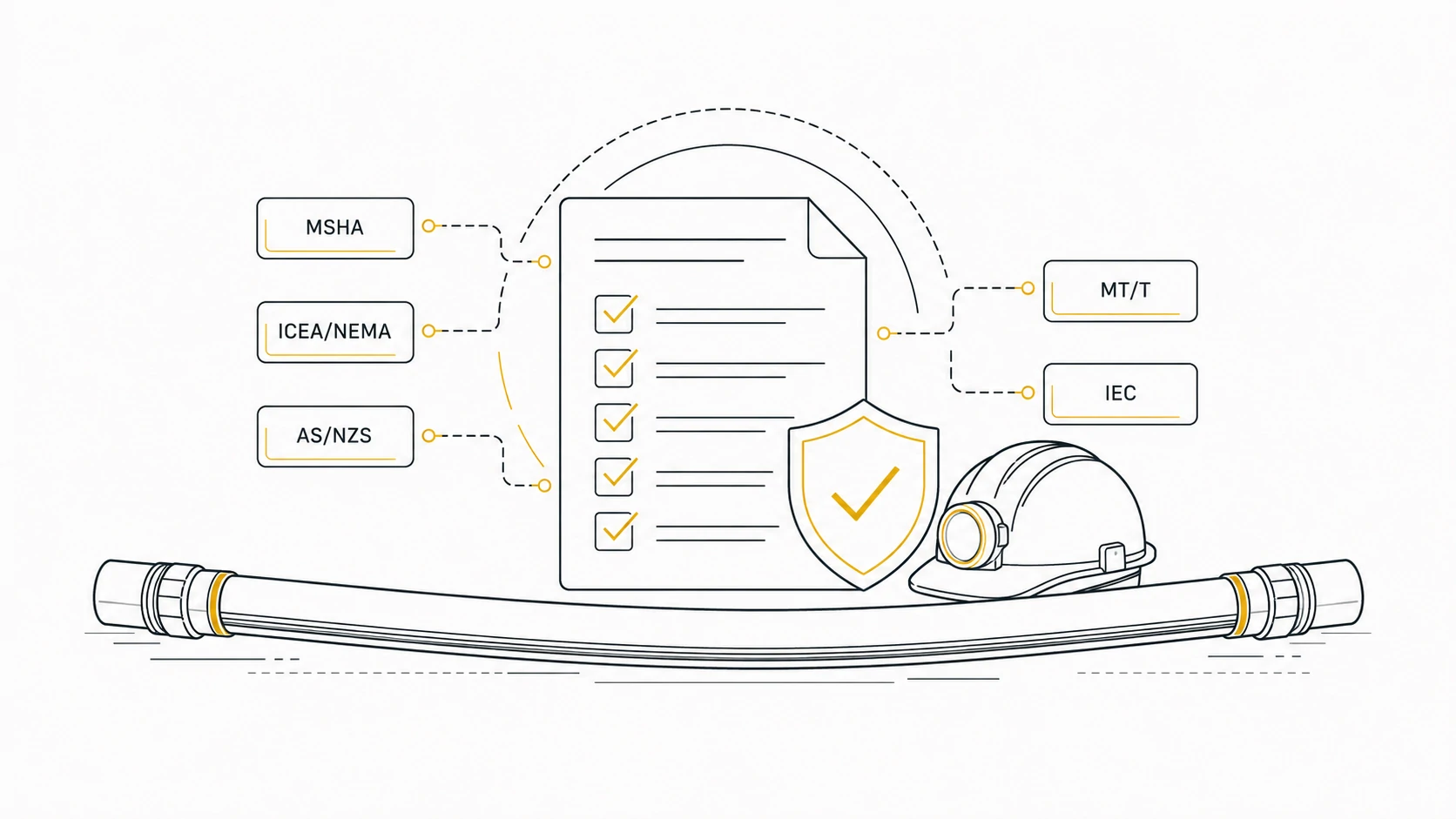
The correct mining cable standards depend on the destination country, mine type, equipment, voltage and whether the cable remains fixed, trails behind a machine or runs on a reel. A cable can pass one flame test yet still lack the construction, approval or mechanical performance required at the mine.
This guide compares mining cable standards by function so engineers and buyers can specify the right evidence before placing an order.
What Standards Apply to Mining Cables?
The applicable mining cable standards normally form a compliance package rather than a single reference. That package may contain a law or mine rule, a product construction standard, one or more test methods and a project-specific specification.
Regulation, Product Standard and Test Method
The first step is to identify what each document actually controls. Treating a test method as a product approval—or a voluntary construction standard as a legal authorization—creates a gap that may not be discovered until inspection or commissioning.
| Compliance layer | Question it answers | Typical examples | Evidence to request |
|---|---|---|---|
| Regulation or market acceptance | May this cable be used at this mine? | U.S. 30 CFR/MSHA requirements; Chinese coal-mine safety rules and the MA safety mark | Approval or certificate number, holder, status and exact product scope |
| Product standard | How must the cable be designed and tested? | ICEA S-75-381/NEMA WC 58; AS/NZS 1802; AS/NZS 2802; MT/T 818 | Cable designation, standard edition, datasheet, type-test and routine-test records |
| Test method | How is one property measured? | 30 CFR §7.407 flame test; IEC 60332 flame propagation; IEC 60331 circuit integrity | Laboratory report identifying the sample, test edition, conditions and result |
| Project specification | What does this equipment and site require? | Voltage, core arrangement, ground-check circuit, reel duty, coupler and drum length | Approved datasheet, drawings and purchaser/manufacturer deviation schedule |
Passing IEC 60332, for example, supports a defined flame-propagation claim. It does not by itself prove compliance with all construction clauses of mining cable standards or grant MSHA approval.
Why the Destination Market Matters
Destination determines the legal framework, while the application determines the cable family inside that framework. At minimum, confirm these five inputs before selecting mining cable standards:
- Jurisdiction and authority: country, state or province, mine regulator and the authority accepting the installation.
- Mine classification: underground coal, gassy underground metal/nonmetal, other underground mine, surface mine or a non-mining reeling application.
- Movement duty: fixed, portable, trailing, reeling, torsional or continuously flexing.
- Electrical system: U0/U(Um), frequency, grounding method, fault level, protection settings and required power, grounding, pilot or ground-check conductors.
- Equipment interface: machine approval, cable type, coupler, gland, reel diameter, pulling load and allowable cable length.
These inputs stop buyers from selecting mining cable standards by voltage alone. A U.S. underground application may require an MSHA-approved flame-resistant cable and an ICEA/NEMA construction. An Australian underground coal project may call for AS/NZS 1802, while another mining or general reeling application may call for AS/NZS 2802. A Chinese coal-mine cable may need the applicable MT/T 818 product part, the mandatory national safety baseline and a valid MA safety mark.
What Does MSHA-Approved Mining Cable Mean?
Within U.S. mining cable standards, “MSHA-approved mining cable” usually means that the identified cable design has received MSHA approval or legacy acceptance for flame resistance within a defined scope. It does not mean that every cable made by the company, or every size carrying a similar trade name, is covered.
MSHA Acceptance and Flame-Resistance Requirements
Among U.S. mining cable standards and rules, MSHA flame approval is a regulatory product-control step, not a synonym for ICEA construction compliance. 30 CFR Part 7, Subpart K establishes flame-resistant approval requirements for electric cables, signaling cables and cable splice kits. 30 CFR §18.35 requires portable cables and cords supplying face equipment to be accepted as flame resistant under Part 18 or approved under Part 7, Subpart K.
The electric-cable test in §7.407 provides a useful picture of what the approval proves:
- Three cable specimens, each 3 ft long, are tested.
- Power conductors are heated at five times the stated ampacity until they reach 400°F (204.4°C).
- A specified gas flame is applied for 60 seconds.
- Each specimen must stop burning within 240 seconds and have no more than 6 in of charred length.
Those criteria verify performance under that defined flame test. They do not establish reel life, abrasion resistance, crush resistance, chemical compatibility or suitability for every mine. This is why mining cable standards for construction and duty must be checked separately.
The wording also matters. Part 18 uses “accepted as flame resistant,” while Part 7, Subpart K uses “approval.” Buyers often use “MSHA approved” for both, but the procurement document should identify the actual approval basis.
How to Verify an Approval Number and Product Scope
Approval-number verification is part of applying mining cable standards correctly: check the exact cable supplied, not just the manufacturer’s name. Under §7.409, approved cable must carry a permanent MSHA-assigned marking at intervals no greater than 3 ft. The marking includes the approval number, conductor number and size, cable type and voltage rating.
Use this verification sequence:
- Read the jacket marking from the offered cable or reel photograph.
- Check the number in MSHA’s List of Approved Products or obtain the approval letter from the approval holder.
- Match the holder and manufacturing identity. A number assigned to another manufacturer cannot be copied onto an unrelated product.
- Match the approved scope: cable type, round or flat construction, conductor count and gauge, voltage, material system and any listed extensions.
- Confirm production traceability: reel number, manufacturing date, routine-test record and marking continuity.
Material or basic-design changes can affect an approval. MSHA also provides for post-approval product audits, so an old certificate image without scope or current production traceability is weak evidence under U.S. mining cable standards.
How Do ICEA S-75-381/NEMA WC 58 and MSHA Differ?
The U.S. mining cable standards framework separates construction from regulatory acceptance: ICEA S-75-381/NEMA WC 58 tells a manufacturer how specified cable families are built and tested, while MSHA determines whether a defined design satisfies applicable federal mine-safety approval requirements. Many projects need both, but the two claims prove different things.
Cable Construction Standard
Among construction-focused mining cable standards, ANSI/NEMA WC 58/ICEA S-75-381-2017 covers portable and power-feeder cables used in mines and similar applications. Its scope includes portable cables for mining machines, dredges and shovels; mine power cables between distribution units; and remote-control and drill cords. The current ICEA document catalogue lists the paired NEMA WC 58/ICEA S-75-381 publication.
The standard organizes constructions by duty and voltage, including:
- Portable cables at 2,000 V or less, including Types W, G and G-GC.
- Portable cables from 2,001 to 5,000 V and from 5,001 to 25,000 V.
- Mine power cables from 2,001 to 25,000 V, including 100% and 133% insulation levels.
- Shielded types such as SHC-GC and SHD-GC, with defined grounding, ground-check, shielding and control-core arrangements.
This breadth makes it one of the principal mining cable standards for U.S.-style cable construction. It also addresses conductors, insulation, shields, jackets, dimensions, ampacities and physical/electrical tests. The ANSI standard record identifies the 2017 edition and its full title.
ICEA and NEMA develop the standard; they do not certify every product sold as compliant. The buyer still needs a manufacturer’s declaration backed by drawings and appropriate test records.
Regulatory Acceptance and Mine Use
Using both layers of mining cable standards correctly means that MSHA compliance cannot be inferred from an ICEA datasheet, and ICEA compliance cannot be inferred from an MSHA number. The distinction is easiest to see side by side.
| Point | ICEA S-75-381/NEMA WC 58 | MSHA cable approval/acceptance |
|---|---|---|
| Primary role | Product construction and testing standard | Federal mine-safety approval or acceptance |
| Main focus | Electrical, dimensional, material and mechanical construction across named cable types | Flame resistance and controlled approved design within the regulatory program |
| Issuing body | ICEA/NEMA consensus process | U.S. Mine Safety and Health Administration |
| Evidence | Standard designation, cable type, drawings and test reports | MSHA marking, approval number and matching approval scope |
| Automatic equivalence? | Does not automatically grant MSHA approval | Does not automatically prove every ICEA clause |
A workable U.S. RFQ therefore turns mining cable standards into two explicit requirements when both apply: the exact ICEA/NEMA cable type and edition, plus the required MSHA approval and approval-number evidence.
AS/NZS 1802 vs AS/NZS 2802
These two mining cable standards divide primarily by environment: AS/NZS 1802 addresses underground coal mining, while AS/NZS 2802 excludes underground coal mining. Asking only for “AS/NZS mining cable” leaves the most important choice unresolved.
Underground Coal Mining
Of the two mining cable standards, AS/NZS 1802:2018covers electric reeling and trailing cables for underground coal mining. It is the relevant starting point when a cable repeatedly moves with underground coal-mining machinery or is handled through a cable reel in that environment.
The standard number alone is still insufficient for manufacture. The purchaser must identify the applicable cable designation, voltage, conductor arrangement, machine duty and interface requirements. The mine’s electrical engineering controls and local regulations may add conditions beyond the product standard.
Do not replace AS/NZS 1802 with a general flexible-cable or flame-test reference solely because the nominal voltage matches. Underground coal duty brings together mechanical movement, electrical protection, grounding and mine-specific fire risk.
Other Mining and General Reeling/Trailing Use
For other applications, the mining cable standards route shifts to AS/NZS 2802:2000, which covers electric reeling and trailing cables for mining and general use other than underground coal mining. It may be relevant to surface-mining machines and other reeling or trailing equipment, subject to the project’s selected cable type and local rules.
| Selection question | AS/NZS 1802 | AS/NZS 2802 |
|---|---|---|
| Underground coal mine? | Yes—this is its defined environment | No—underground coal is excluded |
| Other mining or general reeling/trailing duty? | Not the general default | This is the relevant starting scope |
| Enough to quote the number alone? | No—state designation, voltage, cores and duty | No—state designation, voltage, cores and duty |
These mining cable standards cover new-cable selection, but repair introduces another document. AS/NZS 1747:2022 covers repair, testing and fitting of accessories for reeling, trailing and feeder cables used in mining. A new-cable compliance statement does not automatically validate a later repair.
Is IEC 60502 a Mining Cable Standard?
Within a review of mining cable standards, IEC 60502 belongs in the fixed-power-cable column, not the dedicated mobile trailing or reeling column. It can be relevant to a fixed mine distribution circuit, but the project must address the mining environment separately.
What IEC 60502 Actually Covers
Comparing IEC 60502 with dedicated mining cable standards starts with its stated scope: extruded-insulation power cables divided by voltage range and fixed-installation duty. The two cable parts most often cited are:
| Standard | Rated-voltage scope | Stated application |
|---|---|---|
| IEC 60502-1:2021 | 1 kV and 3 kV classes | Fixed installations such as distribution networks or industrial installations |
| IEC 60502-2:2014+AMD1:2024, corrected 2026 | 6 kV to 30 kV classes | Fixed distribution or industrial installations; special conditions including the mining industry are excluded from its scope |
IEC 60502 addresses matters such as conductor construction, insulation and sheath dimensions, electrical tests and, depending on the part and design, screens and water-blocking provisions. It does not create a universal “IEC mining cable” category.
A fixed feeder installed in a mine may legitimately be specified to IEC 60502 when the regulator, engineering design and site rules allow it. That does not make the same construction suitable for a shearer, shuttle car, drill, dragline or reeling machine.
Why a General Power Cable Standard May Be Insufficient
Dedicated mining cable standards address mobile-duty failure modes that a fixed-installation standard does not cover as a complete system. Depending on the machine and market, the missing requirements may include:
- Repeated flexing, torsion and reverse bending.
- Reeling tension, minimum drum diameter and fleet-angle control.
- Crushing, impact, abrasion, cut and tear resistance.
- Oil, water, ozone, sunlight, mud or chemical exposure.
- Grounding, ground-check, pilot and monitoring conductors.
- Individual phase shields and shield-continuity requirements.
- A mine-specific flame test, approval marking and regulatory certificate.
- Compatibility with the machine approval, gland, coupler and protection settings.
“IEC 60502 compliant” is also incomplete even for fixed cable. Sound use of mining cable standards identifies the part and edition, U0/U(Um), conductor material and size, insulation, screen, armour or protection system, sheath compound, installation conditions and required tests.
Is Mining Cable Flame-Resistant, Fire-Resistant or Explosion-Proof?
Mining cable standards use these terms for different safety functions, so they should never be treated as synonyms. The safest approach is to replace each broad adjective with a named test, acceptance criterion and required evidence.
The Difference Between the Three Terms
| Term | Verifiable meaning | What it does not prove |
|---|---|---|
| Flame-resistant or flame-retardant | Limits burning or flame propagation under a named method, such as MSHA’s Part 7 cable test or IEC 60332-1-2 | Continued electrical operation during a fire; compliance with every mining cable standard |
| Fire-resistant | Maintains circuit integrity for stated fire conditions, duration and, where applicable, mechanical shock; the IEC 60331 series contains such methods | That the cable will not burn, or that it has MSHA or mine-market approval |
| Explosion-proof | A protection concept applied to equipment, enclosures and the installed Ex system; IEC 60079-14 covers selection and installation of Ex equipment | A generic property created by a thick or flame-resistant cable jacket |
A compliant mining cable may be suitable within an explosion-protected installation, but the complete design also includes the equipment protection concept, cable entries, glands, seals, terminations, bonding and installation rules. Describing the cable alone as “explosion-proof” hides those interfaces.
How to Write the Requirement Correctly in an RFQ
A good RFQ converts mining cable standards into measurable requirements and documentary proof instead of using “fireproof” or “explosion-proof mining cable.” These examples show the difference.
| Vague RFQ wording | Procurement-ready wording |
|---|---|
| “MSHA cable” | “Cable shall have MSHA flame-resistance approval under 30 CFR Part 7, Subpart K. State the approval number and provide evidence that the offered type, size, conductor count and voltage are within scope.” |
| “ICEA mining cable” | “Cable shall be Type SHD-GC [or the selected type] to ANSI/NEMA WC 58/ICEA S-75-381-2017, with the stated voltage, power cores, grounding conductors and ground-check conductor.” |
| “IEC flame-retardant” | “Cable shall pass [named part and edition of IEC 60332], with a test report identifying the offered construction.” |
| “90-minute fireproof cable” | “Cable shall maintain circuit integrity for [duration] under [named IEC 60331 part, temperature, voltage and shock/water condition].” |
| “Explosion-proof cable” | “Cable, glands and terminations shall be suitable for the classified area and selected Ex equipment protection concept under the project’s IEC 60079 installation design.” |
A practical RFQ sentence can follow this structure:
Supply [quantity and drum lengths] of [fixed/trailing/reeling] mining cable for [machine and mine type] in [destination market], rated [U0/U(Um)], with [power-core, grounding, ground-check/pilot and control-core arrangement], manufactured to [exact product standard, edition and cable type], carrying [required market approval and number], and supported by [approval scope, datasheet, type-test and routine-test documents]. Mechanical and environmental duty: [bend/reel/tension/abrasion/oil/water/temperature requirements].
Mining Cable Compliance Matrix by Market
This mining cable standards matrix is a starting point for procurement, not a substitute for the authority having jurisdiction or the mine’s approved electrical design. Project specifications can add stricter conditions, and the exact edition must be confirmed before manufacture.
United States, Australia/New Zealand and China
| Market | Main standards or approval route | What to verify before purchase |
|---|---|---|
| United States | Applicable 30 CFR mine rules; MSHA flame approval under Part 7, Subpart K or recognized legacy acceptance; ICEA S-75-381/NEMA WC 58 where specified | Mine classification, equipment approval, cable type, voltage and protection; MSHA number, holder, marking and exact scope; ICEA/NEMA construction evidence |
| Australia/New Zealand | AS/NZS 1802 for underground coal reeling/trailing cable; AS/NZS 2802 for other mining/general reeling and trailing use; local regulation and project rules | Mine environment, cable designation, edition, voltage, core arrangement, movement duty, accredited test evidence and any local/site acceptance |
| China | GB 43069-2023, the applicable MT/T 818 series product part, coal-mine rules and MA safety-mark requirements where applicable | Exact model and voltage, mobile or fixed family, current standard basis, MA certificate holder/number/validity/scope, cable marking and type/routine test documents |
Within China’s mining cable standards framework, GB 43069-2023 is a mandatory national standard for mine-cable safety requirements and took effect on April 1, 2025. It provides a current safety baseline; MT/T 818 supplies detailed requirements for particular coal-mining cable families. They should be read together with certification and mine-use rules rather than treated as competing labels.
MT/T 818 is a 13-part product family, not one universal cable designation. Part 1 gives general requirements for mobile flexible cables, while later parts address defined shearer, mobile, drill and fixed-installation families. As one example, MT/T 818.7-2009 covers shielded mobile flexible cables at 1.9/3.3 kV, 3.6/6 kV and 6/10 kV and specifies construction, electrical tests, flame tests and a minimum bending radius of six times the cable diameter. The RFQ must name the part that matches the offered model and use.
How to Confirm Project-Specific Requirements
Freeze the mining cable standards and approval basis in writing before price comparison or production. Use this eight-point review:
- Name the jurisdiction: country, state/province, mine regulator and approving authority.
- Define the mine and location: underground coal, other underground, surface, shaft, tunnel or plant area.
- Define movement: fixed, intermittent movement, trailing, reeling or continuous torsional flexing.
- Supply electrical data: U0/U(Um), frequency, load current, starting current, grounding system, fault level and protection settings.
- State the complete construction: cable type, cores and sizes, grounding, ground-check/pilot, screens, armour, sheath and accessories.
- Name every compliance document: regulation, product standard, edition, test method and approval scheme.
- List acceptance evidence: certificate and scope, jacket marking, datasheet, drawings, type tests, routine tests and reel traceability.
- Resolve conflicts: law and regulatory approval come first; then record any stricter project, equipment-manufacturer or mine-site requirements in the purchase specification.
If an enquiry says only “MSHA/IEC mining cable,” it is not ready to quote. MSHA and IEC 60502 serve different functions, and combining their names does not define a cable. Confirm the market, mine type, movement duty, voltage, core arrangement, length and documentary scope first. That step turns mining cable standards from marketing labels into an auditable procurement requirement.
For a specification review, send HUALUO CABLE the destination market, mine type, equipment, voltage, core arrangement, required standard and total length. We can then confirm the feasible construction and document scope before quotation.