
H1Z2Z2-K vs PV1-F Solar Cable: Model Codes and Project Selection
The main distinction in H1Z2Z2-K vs PV1-F is the specification behind the designation: H1Z2Z2-K is associated with EN 50618, while PV1-F is historically associated with TÜV 2 PfG 1169/08.2007. A replacement decision must also verify the actual cable ratings, installation conditions and project approval requirements. Source: Prysmian solar cable catalogue.
For procurement, we recommend comparing the exact products offered, with supporting documents for each. Two quotations carrying different model names may share several construction features, while two cables carrying the same designation may have different installation permissions.
What Does H1Z2Z2-K Mean?
H1Z2Z2-K identifies a harmonized photovoltaic cable type with cross-linked, halogen-free insulation and sheath, and a flexible conductor. Products conforming to EN 50618 are intended for photovoltaic applications, including DC connections between modules and inverters. Source: NKT H1Z2Z2-K.
Reading the Cable Designation
Read H1Z2Z2-K as a construction and rating designation; conductor size appears separately. The following breakdown supports an initial H1Z2Z2-K vs PV1-F comparison.
| Code element | Meaning | Purchasing implication |
|---|---|---|
| H1 | Harmonized PV cable designation associated with the voltage category | Check the complete AC and DC ratings in the datasheet |
| First Z2 | Cross-linked, halogen-free insulation compound | Verify the declared insulation construction |
| Second Z2 | Cross-linked, halogen-free sheath compound | Verify the outer-sheath specification |
| -K | Flexible, fine-stranded conductor | Check conductor class and terminal compatibility |
Manufacturer documentation commonly declares 1.0/1.0 kV AC and 1.5/1.5 kV DC for this cable type. The two Z2 elements describe separate material layers; they do not specify the number of conductors. Source: TT Cables H1Z2Z2-K.
For example, H1Z2Z2-K 1 × 6 mm² identifies one conductor with a nominal cross-sectional area of 6 mm². The 1 × 6 mm² marking supplies the core-count and size information.
Connecting the Model Code to the Product Datasheet
The datasheet must connect the designation to measurable properties and permitted installation conditions. When reviewing solar cables, request documentation covering the exact size and product reference quoted.
Check these fields before accepting an H1Z2Z2-K vs PV1-F comparison:
- Conductor: material, strand class and maximum DC resistance.
- Electrical rating: AC/DC designation and any maximum operating-voltage conditions.
- Dimensions: insulation thickness, sheath thickness and overall diameter.
- Temperature: operating limits, installation limits and any time-limited overload rating.
- Installation: bending radius, burial permission and water-exposure conditions.
- Compliance: standard edition, certificate reference and covered size range.
Matching conductor area does not guarantee matching outside diameter. A replacement cable can require a different connector seal or cable gland even when both products are marked 6 mm².
What Does PV1-F Mean?
PV1-F is an established photovoltaic cable designation associated with the earlier TÜV 2 PfG 1169/08.2007 specification. It remains relevant when reviewing existing installations, legacy drawings and previously approved material schedules. Source: Prysmian solar cable catalogue.
The PV1-F Designation and Its Specification Background
PV indicates photovoltaic application, while F identifies flexible construction; the complete PV1-F designation must be read alongside its governing specification. The numeral should not be treated as a standalone statement of the cable’s permitted DC system voltage.
For H1Z2Z2-K vs PV1-F selection, avoid the blanket claim that “PV1-F is only a 1,000 V DC cable.” Published PV1-F datasheets use different AC/DC rating presentations and may include separately qualified maximum-voltage values.
For example, one published PV1-F product declares:
| Parameter | Declared value for this product |
|---|---|
| AC rated voltage, U₀/U | 0.6/1 kV |
| DC rated voltage, U₀/U | 0.9/1.5 kV |
| Maximum DC voltage | 1.8 kV, with stated system and operating conditions |
These values describe that particular product, not every cable sold as PV1-F. Its maximum-voltage statement must be read with the accompanying restrictions. Source: HAL-SOLAR PV1-F technical data.
Why the Actual Certificate and Datasheet Matter
A certificate establishes the assessed product scope, while the datasheet describes the product being offered. Both documents must correspond to the cable supplied.
A useful H1Z2Z2-K vs PV1-F document review checks:
- Manufacturer and product identity: the certificate must cover the quoted cable.
- Specification and edition: record the actual assessment basis.
- Size range: confirm that the ordered conductor area is included.
- Certificate status: verify through the issuing body where possible.
- Traceability: reconcile cable marking, reel labels and delivery records.
We recommend resolving inconsistent voltage claims before purchase. A quotation stating “1,500 V” and a datasheet listing a differently qualified rating require clarification from the manufacturer; the buyer should not infer equivalence.
What Is the Difference Between H1Z2Z2-K and PV1-F?
H1Z2Z2-K vs PV1-F primarily compares different specification backgrounds, with substantial overlap in typical construction. Neither name alone establishes every environmental capability or installation permission.
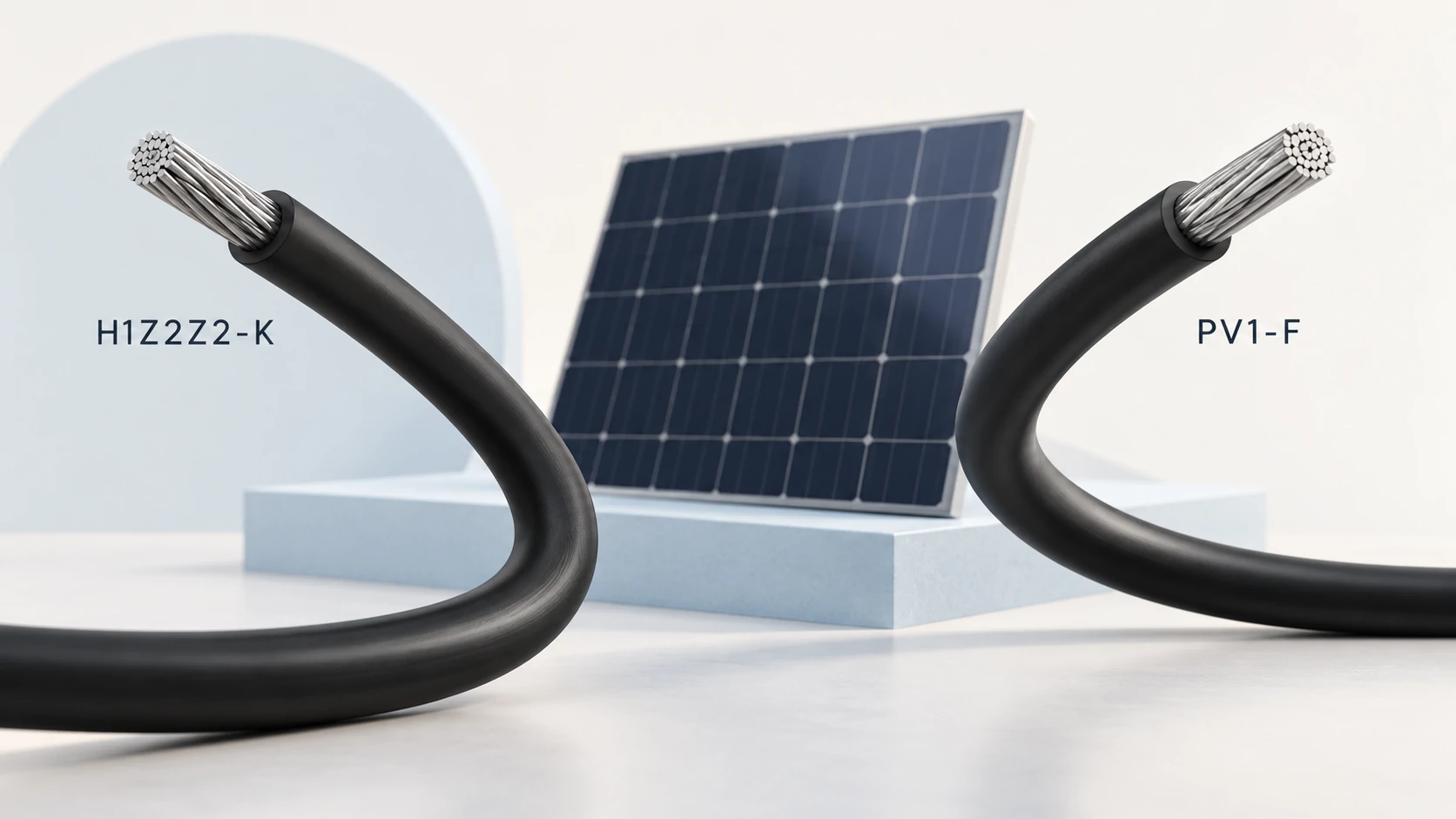
Comparing Declared Voltage, Construction and Test Requirements
Compare voltage ratings on the same basis and test claims against the named specification. A maximum permissible voltage, a rated voltage and a factory withstand-test voltage describe different conditions.
| Comparison point | H1Z2Z2-K | PV1-F | Project check |
|---|---|---|---|
| Specification background | EN 50618 | Historically TÜV 2 PfG 1169/08.2007 | Required standard and accepted edition |
| Voltage declaration | Commonly 1.5/1.5 kV DC | Verify the precise declared DC rating and qualifications | Conductor-to-earth and conductor-to-conductor requirements |
| Typical conductor | Flexible tinned copper | Flexible tinned copper in established designs | Material, resistance and cross-section |
| Typical insulation and sheath | Cross-linked, halogen-free compounds | Cross-linked, halogen-free compounds in established designs | Actual construction and dimensions |
| Test evidence | Evidence against EN 50618 and additional claimed standards | Evidence against the specified PV1-F assessment basis | Relevant tests and acceptance criteria |
| Additional capabilities | Product-dependent | Product-dependent | Burial, immersion and other special exposure permissions |
The construction overlap is visible in published H1Z2Z2-K and PV1-F product documentation. It does not establish identical compound formulations or identical performance. Sources: TT Cables H1Z2Z2-K, HAL-SOLAR PV1-F.
For test requirements, request the applicable evidence for electrical insulation, thermal ageing, mechanical performance, weathering and fire behaviour. Matching test names is insufficient if the conditioning, duration or acceptance criteria differ.
A withstand-test voltage does not authorize continuous operation at that voltage. For example, a listed kilovolt test value describes a controlled test condition, not the permitted system voltage.
Separating Model-Level Differences from Product-Specific Features
Burial permission, permanent immersion suitability and repeated-motion performance require product-specific evidence. They cannot be assigned solely from the H1Z2Z2-K vs PV1-F model comparison.
Published H1Z2Z2-K products illustrate this distinction: LAPP’s SOLAR H1 BUR declares tested burial and AD8 permanent-submersion capability, while HELUKABEL’s SOLARFLEX-X permits direct burial but excludes permanent installation in water. Sources: LAPP SOLAR H1 BUR, HELUKABEL SOLARFLEX-X.
Match additional evidence to the actual route:
- Waterlogged underground ducts: verify the permitted water exposure and its duration.
- Coastal arrays: request evidence relevant to the specified salt exposure.
- Moving tracker sections: confirm bending and torsional duty.
- Exposed rooftop routes: check temperature assumptions and current-rating corrections.
We recommend treating each of these as a separate acceptance item. A flexible conductor alone does not establish suitability for continuous tracker movement.
Can H1Z2Z2-K Replace PV1-F in a Project?
H1Z2Z2-K can replace PV1-F when the proposed product meets the electrical and installation requirements and receives the required project approval. A newer specification background does not automatically amend an approved material schedule.
Checking Tender Requirements and Approved Materials
The tender wording determines whether substitution is permitted and who must approve it. Begin the H1Z2Z2-K vs PV1-F substitution review with the approved specification.
| Project requirement | Required action |
|---|---|
| Exact manufacturer and PV1-F product specified | Submit a formal substitution request |
| PV1-F specified with “or approved equivalent” | Demonstrate equivalence against each requirement |
| EN 50618 expressly required | Provide evidence covering the proposed H1Z2Z2-K product |
| Additional national or project certification required | Verify that certification separately |
| Existing connectors retained | Check the connector manufacturer’s cable requirements |
Consider a rooftop retrofit retaining existing connectors. A replacement may satisfy the voltage requirement but fall outside the connector’s permitted cable-diameter range. Electrical compliance alone does not establish termination compatibility.
For a project with a higher DC design voltage, verify the maximum calculated array voltage and the applicable conductor-to-earth conditions. A cable change cannot establish the suitability of the remaining system components.
Preparing a Technical Substitution Comparison
A substitution submission should show a documented result for every project requirement. Use a comparison matrix that identifies unresolved items before ordering.
| Review item | Information to record |
|---|---|
| Product identity | Original and proposed manufacturer, model and reference |
| Standards | Required specification, edition and supporting certificate |
| Voltage | Complete AC/DC declarations and operating qualifications |
| Conductor | Material, nominal area, resistance and class |
| Current capacity | Calculated capacity under the actual installation conditions |
| Physical fit | Overall diameter, bending radius and connector compatibility |
| Exposure | Temperature, UV, moisture and any special environmental duty |
| Approval | Accepted deviations and written project authorization |
For H1Z2Z2-K vs PV1-F replacement, use “verified,” “deviation” or “evidence required” for each item. An undocumented property should remain unresolved.
When requesting a project cable quotation, send the approved specification, conductor size, total metres and installation route. Include the existing product datasheet if substitution is the objective.