
What Is a Mining Cable? Types, Uses and Construction
- What Is a Mining Cable? Types, Uses and Construction
A mining cable is a purpose-built electrical cable for supplying power, control, monitoring or communications in the severe operating conditions found at surface and underground mines. If you are asking what is a mining cable, the key distinction is not simply a thicker jacket: the complete cable must match the equipment, voltage, movement duty, mechanical hazards and rules of the mine where it will operate.
The term covers several cable families rather than one universal design. Common groups include flexible trailing cable, reeling cable, relatively stationary mine power feeder cable, fixed power cable, control and signal cable, and fiber-optic or coaxial communication cable.
| Mining cable family | Typical duty | Typical use case |
|---|---|---|
| Trailing cable | Moves behind mobile equipment | Continuous miners, shuttle cars, drills and mobile loaders |
| Reeling cable | Repeatedly winds onto and off a drum | Cable-reel machines, shovels, draglines and mobile excavating equipment |
| Mine power feeder cable | Relatively stationary or periodically relocated | Power centers, substations, switchgear and mine distribution systems |
| Fixed mining power cable | Installed in a defined route | Shafts, tunnels, conveyors, crushers, pumps and processing areas |
| Control and signal cable | Carries commands or low-energy signals | Interlocks, emergency stops, sensors and remote controls |
| Communication cable | Carries voice, data or video | Fiber, coaxial, tracking and mine communication networks |
Cable names and requirements vary by jurisdiction. North American references include ANSI/ICEA S-75-381/NEMA WC 58, while Australia and New Zealand use standards such as AS/NZS 1802 for underground coal-mining reeling and trailing cables and AS/NZS 2802 for other mining and general applications. Always confirm the latest edition and the mine authority’s requirements before specifying a product. (Sources: ICEA cable documents, AS/NZS 1802:2018, AS/NZS 2802:2000)
What Is a Mining Cable?
A Direct Definition
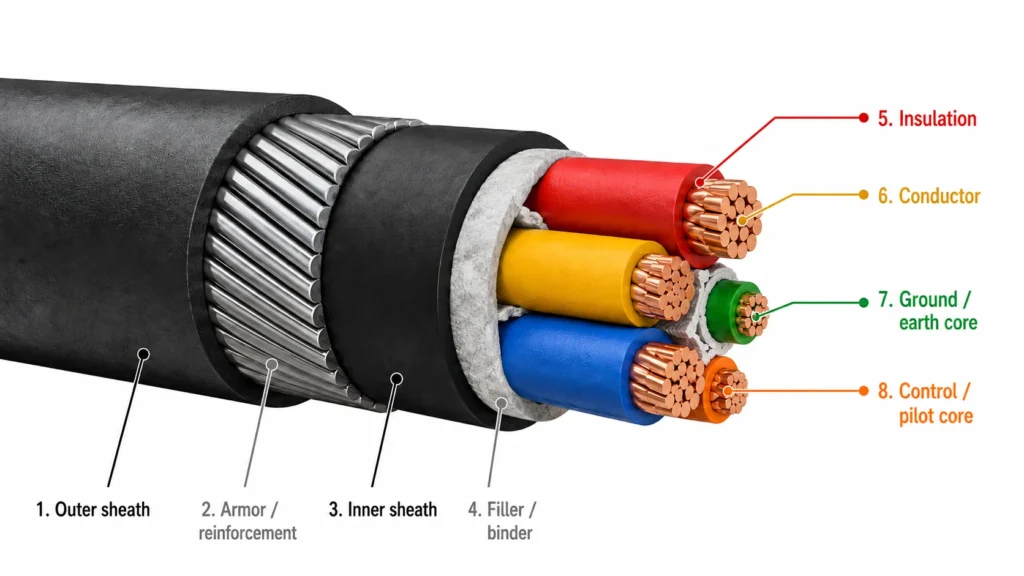
A direct answer to “what is a mining cable?” is that it is a cable engineered and qualified for a defined mining application, not merely an ordinary power cable installed at a mine. Its construction may combine flexible conductors, elastomeric insulation, protective grounding, electrical screens, reinforcement, monitoring cores and a rugged outer sheath.
The intended duty determines the exact meaning of the term. A cable feeding a stationary underground pump can prioritize fire performance and moisture resistance, while a trailing cable behind a continuous miner must also survive repeated bending, dragging, twisting and impact.
U.S. regulations provide a useful but jurisdiction-specific definition. Under 30 CFR Part 18, a portable or trailing cable is a flame-resistant flexible cable or cord that transmits electrical energy from the last accepted short-circuit protective device to a permissible machine or accessory. This definition applies in its regulatory context and should not be treated as a global definition. (Source: 30 CFR Part 18, §18.2)
The Essential Characteristics of a Mining-Grade Cable
What is a mining cable in practical terms? It is a coordinated safety and mechanical system whose layers are selected for a known mine duty. A mining-grade design commonly addresses the following requirements:
- Electrical rating: The conductor size, insulation thickness and screening system must suit the circuit voltage, load, fault level and protection scheme.
- Movement capability: Fine or rope-lay stranded conductors and flexible elastomers help a trailing or reeling cable tolerate repeated bending.
- Mechanical protection: A heavy-duty sheath resists abrasion, cuts, crushing, impact and tearing around rock, equipment and haul roads.
- Protective grounding: One or more grounding conductors provide a low-impedance fault-current path and bond the machine frame.
- Ground monitoring: A ground-check or pilot conductor can form part of a fail-safe circuit that de-energizes equipment if grounding continuity is lost.
- Electrical-field control: Semiconductive screens and metallic shields may be required for medium-voltage or specified low-voltage circuits.
- Fire behavior: Underground applications may require a cable to pass a defined flame test; “flame-resistant” does not automatically mean the cable maintains circuit integrity during a fire.
- Environmental resistance: The compound must be chosen for actual exposure to water, oil, chemicals, sunlight, temperature extremes or other site conditions.
No single feature makes a cable mining-grade. For example, a highly abrasion-resistant jacket cannot compensate for an unsuitable voltage rating, missing ground monitoring or inadequate flex performance.
What Is Mining Cable Used For?
Powering Mobile and Fixed Mining Equipment
What is a mining cable used for most often? Its primary role is to deliver electrical energy safely to equipment that extracts, transports, ventilates, drains or processes material. The cable duty changes according to whether the equipment moves continuously, moves within a work area or remains fixed.
| Installation duty | Representative equipment | Main cable demand |
| Mobile trailing | Continuous miner, shuttle car, roof bolter, mobile drill | Flexibility, abrasion resistance, grounding and strain control |
| Reeling | Electric shovel, dragline, stacker-reclaimer, reel-fed vehicle | Controlled bending, torsion resistance, tensile control and drum compatibility |
| Periodically relocated feeder | Mobile substation, distribution center, portable crusher | Rugged handling, suitable connectors and repeated relocation capability |
| Fixed underground | Pump, fan, conveyor, lighting circuit | Fire behavior, moisture resistance and installation protection |
| Fixed surface | Crusher, concentrator, pump station, workshop | Weather, sunlight, chemicals, mechanical protection and circuit design |
Mobile and fixed cables should not be interchanged solely because their voltage and conductor size match. A fixed cable may be electrically adequate but mechanically unable to tolerate continuous flexing, while a portable cable may add unnecessary size, weight and cost to a protected fixed route.
Commercial mining-cable families illustrate the range of duties and ratings. One North American manufacturer lists non-shielded 2 kV Type G and G-GC, shielded trailing SHD-GC from 2 kV to 35 kV, and relatively stationary MP-GC feeder cable from 5 kV to 35 kV; these are product-family examples, not universal rating limits. (Source: Prysmian mining and tunneling cable families)
Power, Control, Signal and Communication Functions
What is a mining cable used for beyond power transmission? It may support equipment control, protective monitoring, instrumentation, data or communications, either in a composite cable or through a separate dedicated cable. The function must be specified because each circuit type has different electrical and safety needs.
- Power cores energize motors, pumps, fans, conveyors, drills and mobile machines.
- Control cores carry start, stop, interlock, steering or remote-control commands.
- Signal and instrumentation pairs connect sensors for temperature, position, pressure, gas or equipment condition.
- Ground-check conductors monitor the integrity of the protective grounding circuit where the system requires them.
- Fiber-optic, coaxial or twisted-pair cables support voice, video, tracking and operational data networks.
Communication media used at a mine are not automatically approved for every underground location. MSHA separately lists cable, coaxial, fiber-optic and signaling product categories, and its guidance requires fiber used on approved equipment to satisfy flame-resistance, strain-relief and grounding conditions where applicable. (Sources: MSHA approved-product categories, MSHA Volume II guidance)
How Is a Mining Cable Different from a Standard Power Cable?
Mechanical Stress and Repeated Movement
A mining cable differs from a standard fixed power cable chiefly because its design is matched to far more severe movement and mechanical exposure. Trailing and reeling cables can be bent, dragged, twisted, wound onto drums, pulled across irregular ground or exposed to runovers and impact during normal service.
| Design issue | Mining trailing or reeling cable | Standard fixed power cable |
| Normal movement | Repeated or continuous, as specified | Normally stationary after installation |
| Conductor design | Highly flexible stranding may be required | Stranding selected mainly for installation and electrical duty |
| Jacket or sheath | Heavy-duty elastomer with duty-specific resistance | Compound selected for the fixed installation environment |
| Internal geometry | Designed to limit core displacement and torsional damage | Optimized for stable installed geometry |
| Ground monitoring | May include a dedicated ground-check conductor | Not normally part of a conventional fixed power cable |
| Screens and shields | Selected for voltage, safety system and flexibility | Selected mainly for voltage and fixed-system requirements |
| Handling system | May need reels, guides, clamps and strain relief | Usually supported by tray, cleats, conduit or burial system |
An ordinary IEC fixed-installation rating does not establish suitability for mining duty. IEC 60502-2 covers extruded-insulation cables for fixed distribution or industrial installations from 6 kV to 30 kV and explicitly excludes special conditions such as the mining industry. (Source: IEC 60502-2:2014, including the 2024 consolidated amendment)
The practical use case makes the difference clear. A cable fixed to a protected conveyor route experiences a fundamentally different load history from a reel cable on an electric shovel, even when both feed three-phase motors.
Grounding, Shielding, Flame and Environmental Requirements
What is a mining cable required to contain? The answer depends on the governing rules, but grounding, ground monitoring, shielding and verified flame performance can be mandatory rather than optional. These provisions protect people and equipment when insulation is damaged or a ground path is interrupted.
U.S. requirements show why voltage and application must be stated precisely. For permissible equipment rated 661–1,000 V, 30 CFR Part 18 calls for grounding conductors, a ground-check conductor and grounded metallic shielding, subject to a specific reel-cable exception; for 1,001–4,160 V, it calls for grounding conductors, a ground-check conductor and a grounded metallic shield around each power conductor. (Source: 30 CFR Part 18, §18.47)
A grounding conductor and a ground-check conductor perform different jobs. The grounding conductor carries fault current and bonds exposed metal, while the ground-check conductor is part of a monitoring loop used to detect loss of grounding continuity and initiate de-energization.
Flame resistance must always be tied to a named test or acceptance scheme. Under the U.S. Part 18 definition, a flame-resistant cable material stops burning after the applied flame is removed; this is different from a fire-resistant circuit-integrity cable that must continue operating for a specified test period.
Environmental claims must also be specific. A cable described only as “weather-resistant” may still be unsuitable for continuous oil exposure, submersion, aggressive chemicals, low temperatures or repeated abrasion, so the project specification should name each exposure and its required test.
What Is Inside a Mining Cable?
Conductors, Insulation and Grounding Components
What is a mining cable made of at its electrical core? Most power designs begin with stranded copper phase conductors, insulation around each phase and protective grounding components arranged for the required flexibility and voltage. The construction is then built outward according to duty.
- Phase conductors carry load current; flexible designs may use fine, bunched or rope-lay stranding to reduce fatigue under bending.
- Conductor screens may be applied over medium-voltage conductors to create a smooth electrical interface.
- Primary insulation provides dielectric separation; EPR and other elastomeric compounds are common in flexible mining constructions.
- Insulation screens and metallic shields may surround each phase to control the electrical field and provide a defined path for charging and fault currents.
- Grounding conductors bond the equipment frame and form the protective fault-current path.
- A ground-check conductor may complete a monitored grounding loop without serving as the normal fault-current conductor.
Real product constructions show how duty changes the layer system. A 2 kV Type G-GC example uses rope-lay copper phase conductors, EPR insulation, grounding conductors, a ground-check conductor and a reinforced two-layer CPE jacket; a 25 kV SHD-GC example adds conductor and insulation screens plus flexible metallic phase shielding. (Sources: 2 kV Type G-GC construction, 25 kV Type SHD-GC construction)
Screens, Reinforcement and Outer Sheath
The layers outside the insulated conductors stabilize the cable electrically and protect it mechanically. “Screen” and “shield” are sometimes used differently by regional standards, so the drawing should identify whether a layer is semiconductive, metallic or both.
- Semiconductive screens smooth the electric field at conductor and insulation boundaries in screened power cores.
- Metallic shields provide electrical-field containment and a path for capacitive or fault current, subject to the grounding design.
- Fillers and separators maintain a stable round or flat geometry and reduce friction between internal components.
- Textile or composite reinforcement distributes mechanical stress and improves resistance to tension, impact and jacket tearing.
- Inner and outer jackets provide staged protection; a contrasting inner layer can make outer-jacket damage easier to detect in designs that require it.
- The outer sheath or jacket is the first defense against abrasion, cuts, moisture, oil, chemicals, sunlight and temperature exposure.
Reinforcement is not automatically equivalent to metallic armor. A flexible textile-reinforced trailing cable and a steel-armored fixed feeder solve different mechanical problems, and substituting one for the other can reduce flex life or installation safety.
Mining Cable Components and Their Functions
Layer-by-Layer Construction Table
What is a mining cable layer intended to do? Each component should solve a defined electrical, mechanical or safety problem, and not every layer appears in every design. The table below describes a typical shielded flexible power cable from the center outward.
| Layer or component | Primary function | Typical material or form | When it is used |
| Phase conductor | Carries operating current | Flexible stranded copper; bare or coated as specified | All electrical power cables |
| Conductor screen | Smooths the electrical field over the stranded conductor | Extruded semiconductive compound | Screened medium-voltage cores |
| Insulation | Withstands phase-to-ground and phase-to-phase voltage | EPR or another specified dielectric | All insulated power cores |
| Insulation screen | Creates a controlled dielectric boundary | Extruded semiconductive compound | Screened medium-voltage cores |
| Metallic phase shield | Controls the field and provides a current path | Copper wire, braid, textile/copper composite or tape | Where the voltage, protection design or standard requires it |
| Grounding conductor | Bonds equipment and carries fault current | Stranded copper, often arranged symmetrically | Portable and feeder designs requiring protective grounding |
| Ground-check conductor | Monitors protective-ground continuity | Insulated small copper conductor | Fail-safe ground-monitoring systems |
| Control, pilot or communication element | Carries commands, measurements or data | Copper pairs, coaxial element or optical fiber | Composite power/control or dedicated communication designs |
| Fillers and separators | Maintain geometry and reduce component movement | Elastomeric, textile or polymer elements | Multicore round and flat constructions |
| Reinforcement | Shares tensile and impact loads | Textile braid, cords or composite layer | Severe trailing, reeling or tensile duty |
| Inner jacket or bedding | Holds the laid-up core and cushions outer layers | Elastomeric compound | Double-jacket or armored designs |
| Armor, when specified | Protects a relatively fixed cable from impact or crushing | Steel wire, steel tape or other approved armor | Fixed or limited-movement installations—not normal repeated reeling |
| Outer sheath or jacket | Resists the external mine environment | CPE, PCP, TPU or another qualified compound | All complete sheathed cables |
The table is a functional guide rather than a manufacturing specification. Final layer sequence, material, thickness, conductor class and tests must come from the applicable standard, approved drawing and project data sheet.
Optional Components for Different Mining Duties
What is a mining cable likely to add for a special duty? Optional components are chosen only after the movement, hazard and electrical system are known. Typical design responses include:
| Mining duty or hazard | Possible design response | Practical use case |
| Continuous reeling | Flexible conductor, torsion-resistant lay and reinforced sheath | Reel-fed shuttle car or mobile excavator |
| Dragging and runovers | Flat profile or extra-heavy-duty jacket, where the standard permits | Trailing cable crossing rough mine ground |
| Medium-voltage mobile power | Conductor screen, insulation screen and flexible metallic shield | Shielded supply to a high-power mobile machine |
| Ground-continuity monitoring | Ground-check conductor with a compatible relay circuit | Equipment that must trip if the protective ground opens |
| Variable-frequency drive | Symmetrical grounds and an overall EMI-control shield | PWM inverter-to-motor connection near sensitive signals |
| Wet route | Water-blocking or water-resistant system validated for the exposure | Pump station, shaft or washdown area |
| High tensile load | Strength members or reinforced construction | Vertical or suspended section, subject to engineering limits |
| Data and machine control | Shielded pairs, coaxial element or optical fiber | Longwall controls, sensors, video or equipment telemetry |
| Visible damage detection | Contrasting inner and outer jacket layers | Inspection-intensive trailing-cable service |
A composite cable can reduce the number of separate runs but increases termination complexity. Power, control and fiber elements must be electromagnetically compatible, mechanically balanced and accepted for the location.
What Information Is Needed to Identify a Mining Cable?
Cable Marking, Voltage and Core Arrangement
What is a mining cable identified by in the field? The jacket marking and manufacturer’s data sheet should be read together because color or outside diameter alone cannot identify the construction. A useful identification record includes:
- Manufacturer and product family
- Cable type or model designation
- Rated voltage, written in the convention used by the governing standard
- Number and size of power conductors, in mm², AWG or kcmil
- Grounding-conductor number and size
- Ground-check, pilot or control-core arrangement
- Screening or shielding arrangement
- Applicable standard, approval or acceptance marking
- Temperature, flame and environmental ratings, when marked
- Production code, batch or length marking, when supplied
Type codes are regional and should never be decoded by guesswork. For example, G-GC, SHD-GC and MP-GC are familiar North American designations, while other markets use different type numbers or national model codes for comparable duties.
A worn or incomplete marking requires document verification rather than visual assumption. The safest route is to trace the cable to its reel record, certificate, datasheet or approved equipment drawing before energizing or repairing it.
Application and Movement Duty
What is a mining cable specification based on? It starts with the application and movement duty, then adds the electrical, environmental and regulatory requirements. A supplier or cable engineer should receive the following information before recommending a design:
- Country, mine type and governing standard: State whether the site is an underground coal mine, other underground mine, surface mine, quarry or processing plant.
- Equipment and cable function: Identify the machine and whether the cable carries power, control, signals, communications or a combination.
- Movement duty: Define fixed, portable, trailing, reeling, festooned, suspended or periodically relocated service.
- Electrical system: Give rated voltage, AC or DC, phases, frequency, load current or power, starting method, fault level and protection scheme.
- Cable arrangement: State conductor size, number of power cores, grounds, ground-check conductor, control cores and shield type.
- Route and length: Provide installed length, reel dimensions, bending constraints, elevation change and connection points.
- Environment: List temperature range, water, oil, chemicals, UV, abrasion, crushing, impact, methane classification and fire-performance requirements.
- Terminations and logistics: Specify couplers, glands, repair regime, drum length, packaging and inspection documents.
Cable size cannot be selected from equipment power alone. The engineering check must include ampacity, voltage drop, starting current, short-circuit withstand, protective-device operation, installation method, ambient conditions, flex duty and the relevant regulatory limits.
The safest procurement question is therefore broader than “what is a mining cable?” Ask instead: Which approved cable construction matches this exact machine, circuit, movement cycle, environment and mine jurisdiction?
For project-specific product data, compare these requirements with the HUALUO Cable mining cable range and request a construction sheet before ordering.