
Types of Mining Cables for Underground and Surface Mines
The main types of mining cables are trailing cables, reeling cables, mine power feeder cables and cables for fixed installations. Control, signal and communication cables support machine operation, monitoring and mine networks.
These names describe different aspects of a cable’s job. “Power” identifies what it carries; “reeling” identifies how it moves. A reeling power cable therefore belongs to both categories.
Underground and surface mines often use the same broad cable categories. The important differences appear at the application level: a shuttle car repeatedly winds its cable onto a drum, a shovel moves with a heavy supply cable, and a stationary conveyor drive may operate without moving its electrical connection.
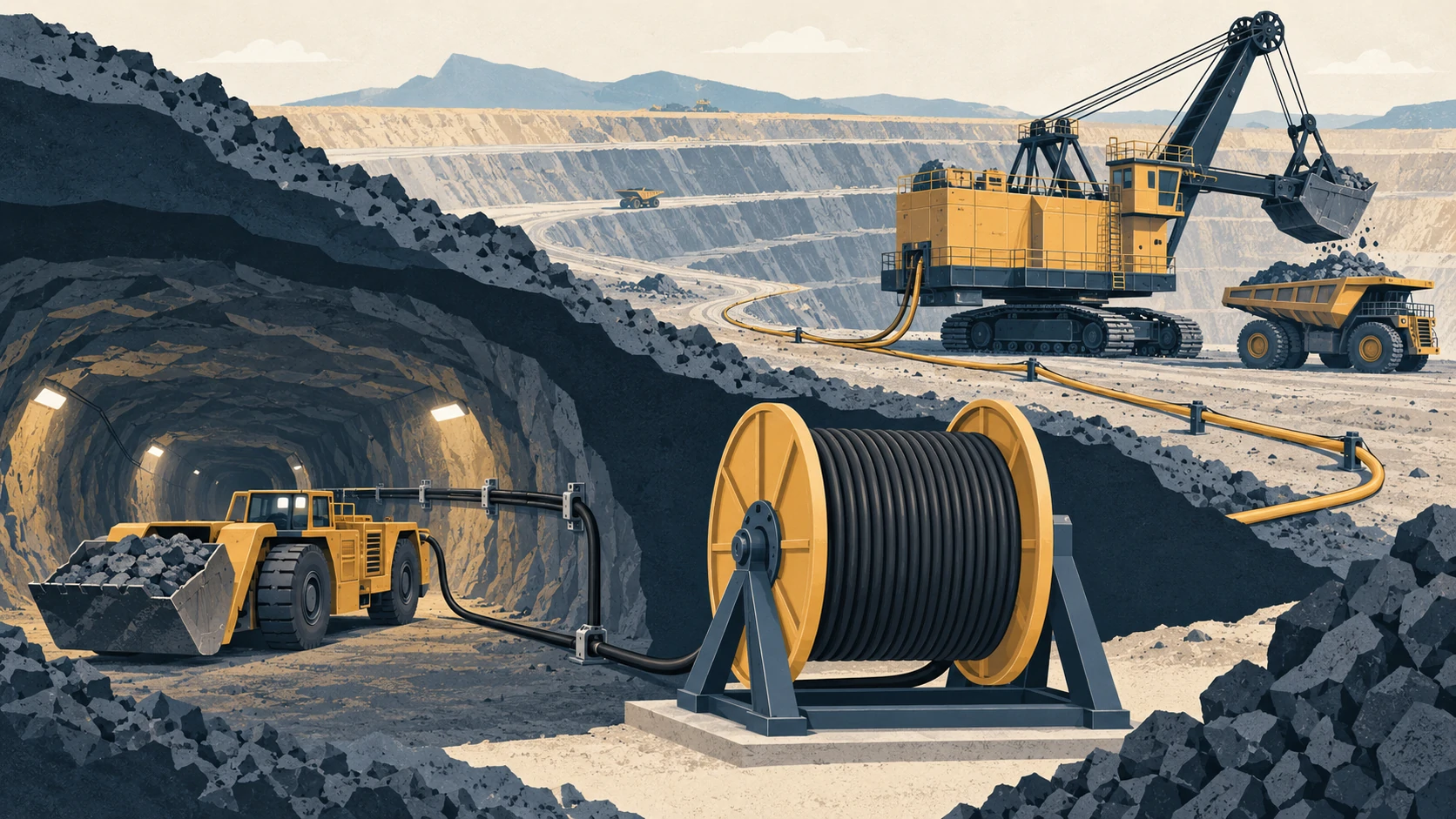
What Types of Cables Are Used in Mining?
Mining cables are best understood through two classifications: how they are installed or moved, and what electrical function they perform. This prevents different terms from being mistaken for interchangeable products.
Trailing, Reeling, Feeder and Fixed Cables
Trailing, reeling, feeder and fixed-installation cables are useful application categories, but they are not four mutually exclusive constructions.
| Cable category | Main purpose or working condition | Typical mining application | Important distinction |
|---|---|---|---|
| Trailing cable | Supplies equipment while following its movement | Continuous miners, mobile drills and electric shovels | Must tolerate the specified movement and handling duty |
| Reeling cable | Winds onto and unwinds from a cable drum | Cable-powered shuttle cars and travelling machinery | Repeated winding requires suitability for the actual reel system |
| Mine power feeder cable | Transfers power between distribution points or to downstream equipment | Supply between mine distribution units | “Feeder” identifies the circuit function |
| Fixed-installation cable | Remains supported in position during normal operation | Stationary distribution and plant circuits | Installation flexibility does not establish continuous-flexing capability |
Trailing and reeling duties can overlap. A cable may trail behind a machine while an onboard reel retrieves it. Some products support both applications; others are designed for a narrower duty.
Feeder and fixed also overlap. Southwire, for example, specifies an MP-GC product for stationary horizontal distribution in permanent or semi-portable installations. That description does not make it a continuously moving machine cable. Source: Southwire MP-GC application specification
Power, Control, Signal and Communication Cables
The electrical types of mining cables include power, control, instrumentation and communication cables. Each serves a different part of the mine’s operating system.
- Power cables deliver electrical energy to motors, transformers and other loads.
- Control cables connect operating commands, interlocks and switching functions.
- Signal or instrumentation cables carry measurements and monitoring information.
- Communication cables carry voice or data between network devices and communication equipment.
These functions may use separate cables or a purpose-designed combined construction. Electro-optic power cables, for example, combine power conductors and optical fibres for longwall equipment. Source: AmerCable underground mining cables
Underground radio systems may also use leaky feeder cable, a radiating coaxial cable that acts as an antenna along a tunnel. Despite the name, it is a communication cable—not a mine power feeder. Source: Becker Mining leaky feeder cable
What Cable Is Used in Underground Mining?
Underground mining uses flexible supply cables near moving machinery and distribution cables along established routes. Working-face equipment, fixed infrastructure and vertical shafts impose different duties, even within the same mine.
Cables for Mobile Underground Equipment
Trailing, reeling and cable-handler-compatible constructions serve different forms of underground movement.
A trailing supply follows a machine as it advances or repositions. A reeling supply experiences repeated winding and unwinding. A cable travelling through a chain or handler follows a constrained bending path, often within limited space.
This distinction matters because the cable’s conductors, core arrangement and reinforcement must work together under that movement. A construction suitable for occasional repositioning does not automatically suit repeated bending through a compact handler.
Longwall shearers illustrate the difference. They travel along the coal face while their cables move through dedicated handling arrangements. Prysmian identifies specially flexible constructions for this duty, including Type 245SF for cable-chain applications. Source: Prysmian underground mining cable applications
The underground location adds another requirement: the cable must meet the applicable mine-use requirements for its intended installation. A surface application description alone does not establish suitability for an underground coal mine.
Cables for Fixed Underground Power Distribution
Mine power feeder cables connect distribution equipment; fixed branch circuits carry power onward to stationary loads. Their normal duty differs from a cable repeatedly retrieved by a moving machine.
Feeder products may be designed for supported open-air routes, ducts or direct burial. Suitability for each installation method must appear in the product specification. Prysmian’s MP-GC range, for example, includes products intended for permanent distribution installations. Source: Prysmian MP-GC feeder cable
Fixed installations may use armoured constructions or other approved forms of mechanical protection. Flexible cables can also be installed in a fixed position; “fixed” describes their operating condition.
Vertical shafts introduce a separate mechanical issue: suspended cable weight. Purpose-designed borehole or suspension cables use an engineered load-bearing arrangement. They should not be treated as an ordinary horizontal feeder hung vertically. Source: Prysmian suspension and mine distribution cables
What Cable Is Used in Surface or Open-Pit Mining?
Surface mines use heavy-duty mobile supply cables around extraction equipment and fixed cables around distribution and processing infrastructure. Outdoor exposure affects both groups, while movement determines whether trailing, reeling or another flexible construction is needed.
Dragline, Shovel and Drill Cables
Electrically powered draglines, shovels and blast-hole drills commonly use heavy-duty trailing cables, with reeling constructions where the handling system requires them.
These machines can place the supply cable in contact with rough ground and expose it to movement during repositioning. The jacket provides protection against specified external stresses, while the internal construction must accommodate the intended bending and handling.
SHD-GC is one example of a shielded mining power cable family used for such equipment. Southwire lists a particular SHD-GC product for shovels, draglines and blast-hole drillers, among other applications. Source: Southwire SHD-GC specification
Slow reeling is also a distinct published duty. Prysmian identifies Type 450 for slow reeling and trailing applications on draglines, shovels and excavators. This should not be interpreted as equivalent to the frequent high-speed reeling associated with shuttle cars. Source: Prysmian open-cut mining cables
Stacker-Reclaimer and Processing Plant Cables
A travelling stacker-reclaimer needs a moving power connection; a stationary processing plant mainly needs fixed circuits.
For a stacker-reclaimer equipped with a cable reel, the appropriate category is a reeling cable compatible with that system. Festoon systems instead support the cable in hanging loops that open and close as the machine travels. AmerCable lists reeling and festoon products for stacker-reclaimers and similar materials-handling equipment. Source: AmerCable reeling application cables
Processing plants contain several electrical duties. Crushers and conveyor drives require power connections, instruments require signal circuits, and control equipment requires communication between devices.
Variable-frequency-drive motor circuits may require a dedicated VFD cable construction. This is an electrical application distinction within the plant, separate from whether the cable is fixed or moving. Source: AmerCable mining infrastructure cables
A single plant can therefore require several types of mining cables rather than one general-purpose specification.
Which Mining Cable Is Used for Different Equipment?
The correct equipment-to-cable match follows the movement of the electrical connection, not simply the movement of the machine’s working parts. The comparisons below concern equipment supplied through an external cable.
Continuous Miners, Shuttle Cars and Roof Bolters
Continuous miners generally need trailing supply cables, cable-powered shuttle cars need reeling-capable supplies, and roof bolters commonly use flexible trailing supplies. Their operating patterns explain the differences.
Continuous miners. The machine advances and changes position as it cuts. Its supply must follow that movement and tolerate the installed handling arrangement. Depending on the electrical system, the cable may require screened power cores and grounding-monitoring provisions. Type 241 is one documented example used for continuous-miner applications in the Australian market. Source: Prysmian Type 241
Shuttle cars. Repeated travel between loading and discharge points can produce frequent reel cycles. A purpose-designed shuttle-car cable addresses this recurring mechanical duty. Prysmian Type 275, for example, is specified for high-speed shuttle-car reeling and resistance to corkscrew deformation. Source: Prysmian Type 275
Roof bolters. The supply follows the machine as it moves between bolting positions, even though the machine may remain stationary while drilling and installing bolts. That makes its external supply different from a permanently fixed plant connection. Roof bolters are among the applications covered by AmerCable’s underground trailing cable range. Source: AmerCable underground applications
These examples identify application categories. They do not make the named regional cable types interchangeable.
Conveyors, Pumps, Draglines and Excavators
Conveyors and pumps demonstrate why equipment function alone does not determine cable type. A moving conveyor belt does not necessarily move the motor’s supply cable, and a pump cable is not necessarily submerged.
For a stationary conveyor drive, a suitable fixed power connection is the starting category. A travelling conveyor section or mobile transfer machine may instead need reeling, festoon or other moving cables.
For pumps, distinguish the feeder to the pump installation from the cable section exposed to water. A submerged section needs an explicit rating for its immersion conditions. Prysmian separately identifies cables for permanent underwater service on submersible pumps and dredgers. Source: Prysmian mining pump applications
Draglines and electrically powered excavators generally bring the focus back to the mobile supply. Some excavators use dedicated cable reels mounted on the machine, so “excavator cable” can involve both trailing and reel-handling requirements. Source: Conductix-Wampfler excavator cable reels
Mining Equipment-to-Cable Selection Table
The table below translates the application distinctions into a practical comparison of types of mining cables. It synthesises the manufacturer applications discussed above; it identifies the starting category rather than a complete replacement specification.
Selection by Movement, Voltage and Environment
Movement identifies the mechanical category, voltage identifies the electrical rating, and environment identifies the required exposure performance. All three must apply to the same proposed cable.
| Equipment or circuit | Normal cable movement | Starting cable category | Why this category fits |
|---|---|---|---|
| Continuous miner | Follows machine advance and repositioning | Flexible trailing supply cable | Accommodates movement of the external power connection |
| Cable-powered shuttle car | Frequent drum payout and retrieval | Shuttle-car reeling cable | Designed for recurring winding and bending duty |
| Roof bolter | Moves between bolting positions | Flexible trailing supply cable | Remains mobile between stationary working periods |
| Longwall shearer | Repeated movement through a cable handler | Shearer cable designed for the handler | Accommodates the constrained bending path |
| Underground distribution route | Normally stationary | Mine power feeder cable | Connects distribution equipment along the approved route |
| Vertical shaft supply | Suspended installation | Feeder with an engineered suspension arrangement | Accounts for cable weight and mechanical support |
| Electric dragline or shovel | Trails or is handled during repositioning | Heavy-duty trailing cable; reeling-rated where needed | Matches the supply’s ground contact and handling duty |
| Mobile electric drill | Follows relocation; may reel | Trailing or reeling cable | Depends on how the rig manages its supply |
| Travelling stacker-reclaimer | Reels or moves in suspended loops | Reeling or festoon cable | Matches the installed power-transfer mechanism |
| Stationary conveyor drive | Supply connection remains fixed | Fixed power cable; suitable VFD cable where required | The cable does not move with the conveyor belt |
| Submersible pump | Often stationary, with a submerged section | Cable rated for the specified immersion duty | Addresses continuous water exposure |
| Mine radio coverage | Fixed communication route | Leaky feeder coaxial cable | Distributes radio signals along the route |
Voltage must then be checked within the chosen category. For example, Prysmian lists G-GC products rated at 2 kV, while its SHD-GC range spans several ratings. “Trailing cable” alone therefore does not specify a voltage. Source: Prysmian portable mining cable ratings
Environmental ratings are equally specific. Outdoor exposure, oil contact and permanent immersion are different conditions. A product suitable for one should not be assumed suitable for all three.
Common Cable Selection Mistakes
The most consequential mistakes occur when a familiar label hides a different operating duty.
- Treating all trailing cables as reeling cables.
Some products support both duties, but trailing suitability alone does not establish performance on a particular reel. - Treating all reeling applications as equivalent.
Frequent shuttle-car reeling and slow cable retrieval on large surface equipment impose different operating demands. - Assuming every feeder is a continuously flexible cable.
A feeder may permit relocation while remaining intended for stationary service during operation. - Choosing by the machine’s movement instead of the cable’s movement.
A conveyor belt can run continuously while its motor connection stays fixed. A roof bolter can work stationary but still need a mobile supply between positions. - Assuming every pump cable can remain underwater.
The dry feeder and submerged motor lead may require different constructions and ratings. - Confusing an application category with a regional model code.
“Reeling cable” describes duty. Names such as Type 275 or SHD-GC describe particular cable families within specific product and standards systems. - Replacing by conductor size and outer diameter alone.
Similar dimensions do not establish equivalent screening, grounding, monitoring or mechanical performance.
For a useful comparison, describe the application before comparing model names: a reeling supply for a shuttle car, a stationary mine feeder, or an immersion-rated pump connection. That description gives the cable category a clear meaning and makes differences between proposed products easier to assess.