
Solar Cable vs Normal Cable: Key Differences
Solar cable vs normal cable comes down to documented suitability for the circuit and its installation conditions. PV array cable is designed for photovoltaic wiring exposed to sunlight and weather. General-purpose wire may serve other parts of a solar installation, but matching conductor size alone does not establish interchangeability.
We recommend checking the exact cable designation before comparing prices. “Normal cable” is a commercial description, not a technical classification: indoor building wire, outdoor power cable and flexible equipment wire have different permitted uses.
What Is the Difference Between Solar Cable and Normal Cable?
The main difference is the combination of environmental performance, insulation construction and electrical ratings. A useful solar cable vs normal cable comparison identifies the actual products being considered rather than assuming every ordinary cable is unsuitable outdoors.
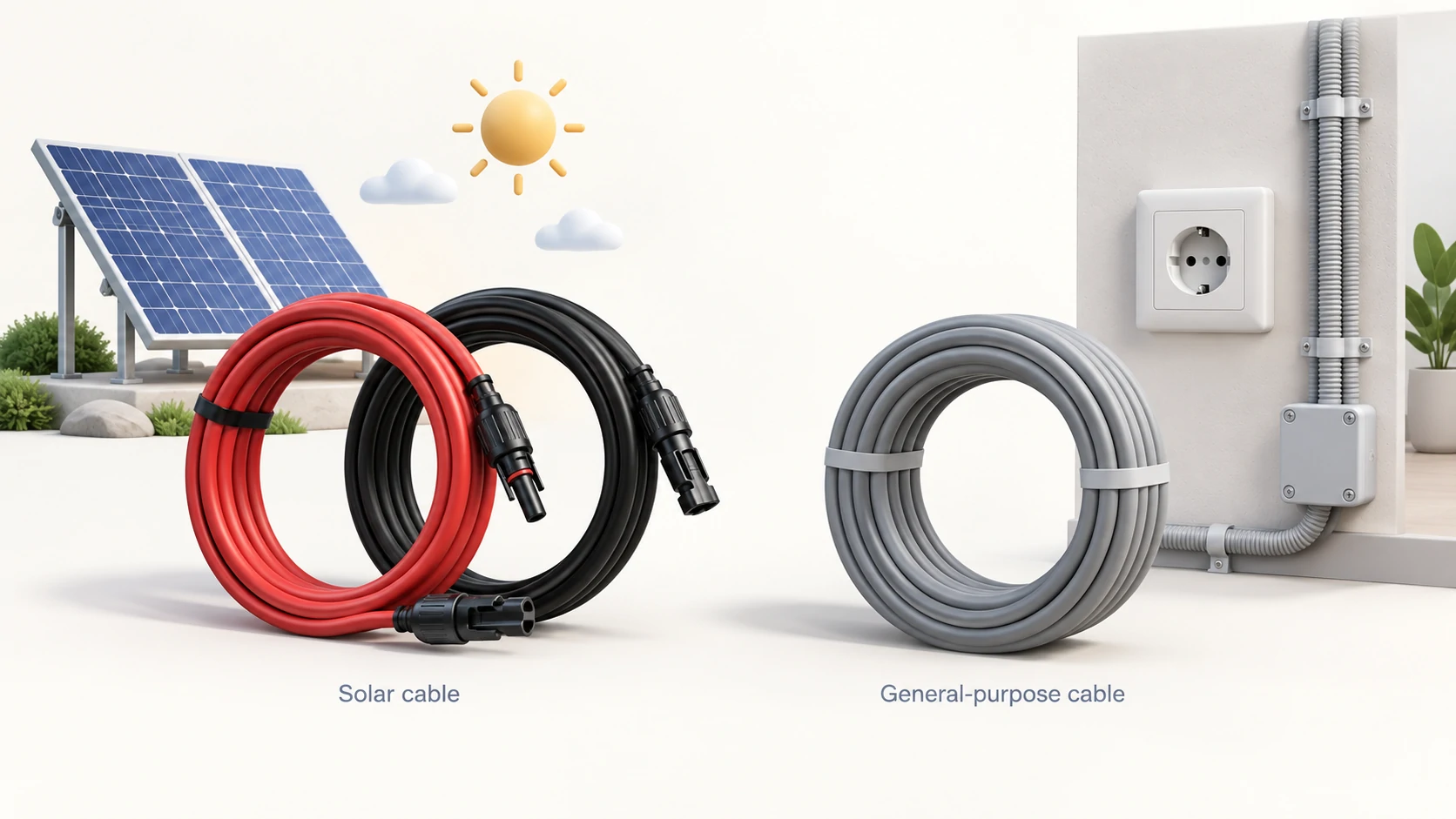
Outdoor Exposure, Insulation and Electrical Ratings
The outdoor requirement in solar cable vs normal cable selection is documented resistance to its outdoor conditions and a voltage rating suitable for the maximum circuit voltage. On a commercial rooftop, module leads encounter sunlight, rain and repeated heating and cooling. Cables underneath modules can still encounter moisture and reflected sunlight.
| Selection factor | PV array cable | General-purpose wire or cable |
|---|---|---|
| Intended use | Photovoltaic circuits within the product’s declared scope | Building, industrial or equipment wiring within its declared scope |
| Outdoor exposure | Check documented UV, ozone and weather resistance | Outdoor suitability varies; an indoor-only product is insufficient |
| Insulation construction | H1Z2Z2-K typically has cross-linked insulation and an outer sheath | May be single-insulated or sheathed; materials vary |
| Voltage | Use the declared DC rating and relevant conductor-to-earth limits | Establish AC/DC applicability from documentation |
| Temperature | Check continuous conductor and installation limits separately | Limits depend on the exact insulation and product designation |
| Water exposure | Verify wet-service, immersion and burial conditions individually | Some products permit wet locations; others do not |
| Current capacity | Calculate for conductor size, route and operating conditions | Requires the same circuit-specific assessment |
EN 50618 and IEC 62930 are relevant product references for PV cables; they do not make every cable sold as “solar cable” identical. Check the supplied product’s certificate scope and technical sheet, including any restrictions on installation.
An outdoor-rated building wire can also have substantial heat and moisture resistance. For example, Cerrowire specifies its USE-2/RHH/RHW-2 product for 90°C wet or dry service, with voltage ratings tied to the designation used. This illustrates why solar cable vs normal cable must compare identified products. (Source: Cerrowire USE-2/RHH/RHW-2)
Why Cable Appearance Does Not Establish Suitability
Appearance cannot settle a solar cable vs normal cable comparison. A black jacket does not establish UV resistance, and a red jacket does not establish a DC voltage rating. A thicker cable may simply contain more insulation or a different sheath compound.
For solar cable vs normal cable purchasing decisions, match the jacket markings to the manufacturer’s technical sheet and certification documents. A readable model number helps identify the product; it does not independently verify every advertised claim.
The distinction between module leads, string wiring and other circuits is explained in what is a solar cable. Identify the circuit first, then assess the cable proposed for that circuit.
Can Ordinary Electrical Wire Be Used for Solar Panels?
For solar cable vs normal cable substitution, ordinary wire is acceptable only where its ratings, wiring method and equipment requirements permit the use. Indoor-only wire should not be substituted for exposed module leads simply because it carries the calculated current.
Exposed Array Wiring and Protected Wiring Routes
Exposed array wiring and protected routes require separate cable assessments. Conduit can reduce sunlight exposure and mechanical damage, but it does not increase the cable’s voltage rating or automatically create a dry location.
| Circuit or route | Substitution assessment |
|---|---|
| Exposed wiring between modules | Use cable permitted for exposed PV wiring and compatible with the installed connectors |
| Array cable entering outdoor conduit | Check applicable wiring rules, moisture conditions, voltage and thermal derating |
| Protected DC route inside a building | Check permitted cable types, enclosure requirements and applicable fire-performance requirements |
| Battery-to-inverter connection | Assess battery-circuit current, fault protection and terminal requirements separately |
| Inverter AC output | Select cable permitted for the AC circuit and its installation method |
A solar cable vs normal cable decision can change where an exposed array route enters a protected installation. Any change in cable type still requires a suitable enclosure and a termination arrangement approved for both conductors.
For an underground conduit run, assume that water exposure needs investigation. A conduit is not a substitute for a required wet-location rating. For a rooftop run, assess grouping and ambient temperature before accepting a current rating taken from a catalogue.
Checking Cable Markings, Installation Rules and Equipment Requirements
A solar cable vs normal cable substitution needs a documented match to the circuit, route and termination system. Our recommendation is to compare the proposed replacement against the original specification line by line.
- Cable identity: manufacturer, model, conductor material and cross-sectional area.
- Voltage suitability: maximum circuit voltage, AC/DC applicability and conductor-to-earth requirements.
- Thermal limits: continuous conductor temperature, ambient conditions and terminal temperature limits.
- Environmental scope: sunlight, moisture, chemicals and mechanical exposure.
- Installation permission: cable type and wiring method accepted under the destination market’s applicable rules.
- Equipment compatibility: conductor class, connector dimensions, lug type and installation instructions.
Do not base a PV string assessment only on the system’s nominal operating voltage. Open-circuit voltage increases as module temperature falls, so the design must account for the specified minimum temperature and module voltage coefficient.
This completes the practical solar cable vs normal cable check: the replacement must meet every relevant requirement. A larger conductor cannot compensate for an unsuitable voltage rating or an unapproved wiring method.
Can Battery Cable or Welding Cable Replace Solar Cable?
The solar cable vs normal cable distinction also applies to battery and welding cables: neither is an automatic replacement for PV array cable. A specific product may be acceptable only when its documented ratings and approvals cover the intended circuit, environment and installation method.
Flexibility and Current Capacity Are Not the Only Criteria
Fine strands and high current capacity do not establish suitability for exposed PV strings. Battery cable may be designed for a different voltage range, while a welding cable’s published current capacity may depend on intermittent welding duty.
In solar cable vs normal cable evaluations, separate these cable families by their intended application.
| Cable family | Intended application | Additional evidence needed for a PV substitution |
|---|---|---|
| PV array cable | Module, string or other specified photovoltaic wiring | Exact voltage, environmental scope and connector compatibility |
| Battery cable | Battery interconnections or battery equipment circuits | PV voltage suitability, outdoor performance and installation permission |
| Welding cable | Welding power circuits | Continuous-duty ampacity, PV installation permission and termination compatibility |
A useful calculated example is a 5 kW load supplied from a nominal 48 V battery: ideal current is approximately 104 A, before conversion losses. That battery connection presents different sizing conditions from a high-voltage PV string, even though both carry DC.
A welding-cable table based on intermittent operation cannot be applied unchanged to continuous PV current. Check the stated duty cycle and installation assumptions before comparing ampacity figures.
Checking Environmental Ratings and Terminal Compatibility
Terminal compatibility can rule out a solar cable vs normal cable substitution even when the electrical ratings match. Two cables with the same conductor area can have different outside diameters, strand constructions and insulation dimensions.
- Conductor size: match the contact or lug’s specified range.
- Stranding: confirm that the terminal accepts the conductor class.
- Outside diameter: stay within the connector gland’s permitted sealing range.
- Assembly: use the specified stripping length, crimp tooling and tightening procedure.
- Environment: verify the cable’s required UV and moisture performance.
- Mating pair: follow the connector manufacturer’s compatibility requirements.
A poor crimp can increase contact resistance; an incorrect cable diameter can compromise the seal. Neither problem is resolved by selecting a larger conductor.
For solar cable vs normal cable substitution, obtain the exact connector instructions alongside the cable technical sheet. Do not describe different connector brands as interchangeable merely because their housings can be pushed together.
Can Solar DC Cable Be Used for AC Wiring?
For AC applications, solar cable vs normal cable selection requires documented AC suitability and permission for the installation method. A DC voltage marking alone does not establish permission for AC building wiring.
Reading Separate AC and DC Voltage Ratings
Use the product’s stated AC rating or documented AC application guidance; do not convert its DC rating yourself. In solar cable vs normal cable comparisons, identical voltage numbers can refer to different rating systems or operating conditions.
The following are illustrative checks, not specifications for an unidentified product.
| Documentation supplied | Interpretation |
|---|---|
| Only “1500 V DC” is declared | AC suitability has not been established by that marking |
| Separate AC and DC ratings are declared | Apply the rating corresponding to the intended circuit |
| An AC rating is expressed as U₀/U | Check conductor-to-earth and conductor-to-conductor voltage separately |
| Only a dielectric test voltage is stated | Do not treat the test voltage as the continuous operating rating |
For example, 1.0/1.0 kV AC, if explicitly declared for the product, represents separate conductor-to-earth and conductor-to-conductor ratings. It should not be inferred from a 1.5 kV DC marking.
A short-duration dielectric test demonstrates performance under defined test conditions. It does not authorize continuous operation at the test voltage.
Confirming the Wiring Method and Intended Application
An adequate AC rating resolves only the voltage part of a solar cable vs normal cable assessment. The cable must also meet the requirements of the installation and connected equipment.
Check the proposed use against:
- Wiring method: conduit, tray, fixed wiring or another specifically permitted arrangement.
- Fire performance: requirements applying to the building and cable route.
- Identification: permitted phase, neutral and protective-conductor identification.
- Termination: conductor flexibility and the terminal’s accepted conductor range.
- Circuit design: ampacity, voltage drop and short-circuit protection.
A cable accepted for an exposed DC array is not automatically accepted as a flexible appliance cord or a building’s AC distribution cable. We recommend specifying each circuit separately when preparing a project cable schedule.
For a project enquiry to Hualuo Cable, provide the destination country, circuit voltage, conductor size and total length, together with the route and connector model. Those details make a solar cable vs normal cable assessment specific enough to support procurement.