
Mining Cable Materials: Conductors, Insulation and Sheath Selection
- Mining Cable Materials: Conductors, Insulation and Sheath Selection
Choose mining cable insulation and sheath materials according to how the cable moves, the electrical duty it carries and the conditions it encounters. Conductors carry current, insulation provides electrical separation, and the outer sheath protects the cable against external damage. Each layer needs its own selection criteria.
EPR insulation is a common starting point for flexible mining cables. XLPE is widely used for fixed power circuits. CPE, PCP and TPU jackets offer different combinations of mechanical and environmental protection, but a material name alone does not establish a cable’s suitability.
For procurement, specify the required performance alongside the material: repeated bending, oil exposure, immersion, abrasion, temperature and applicable mining requirements.
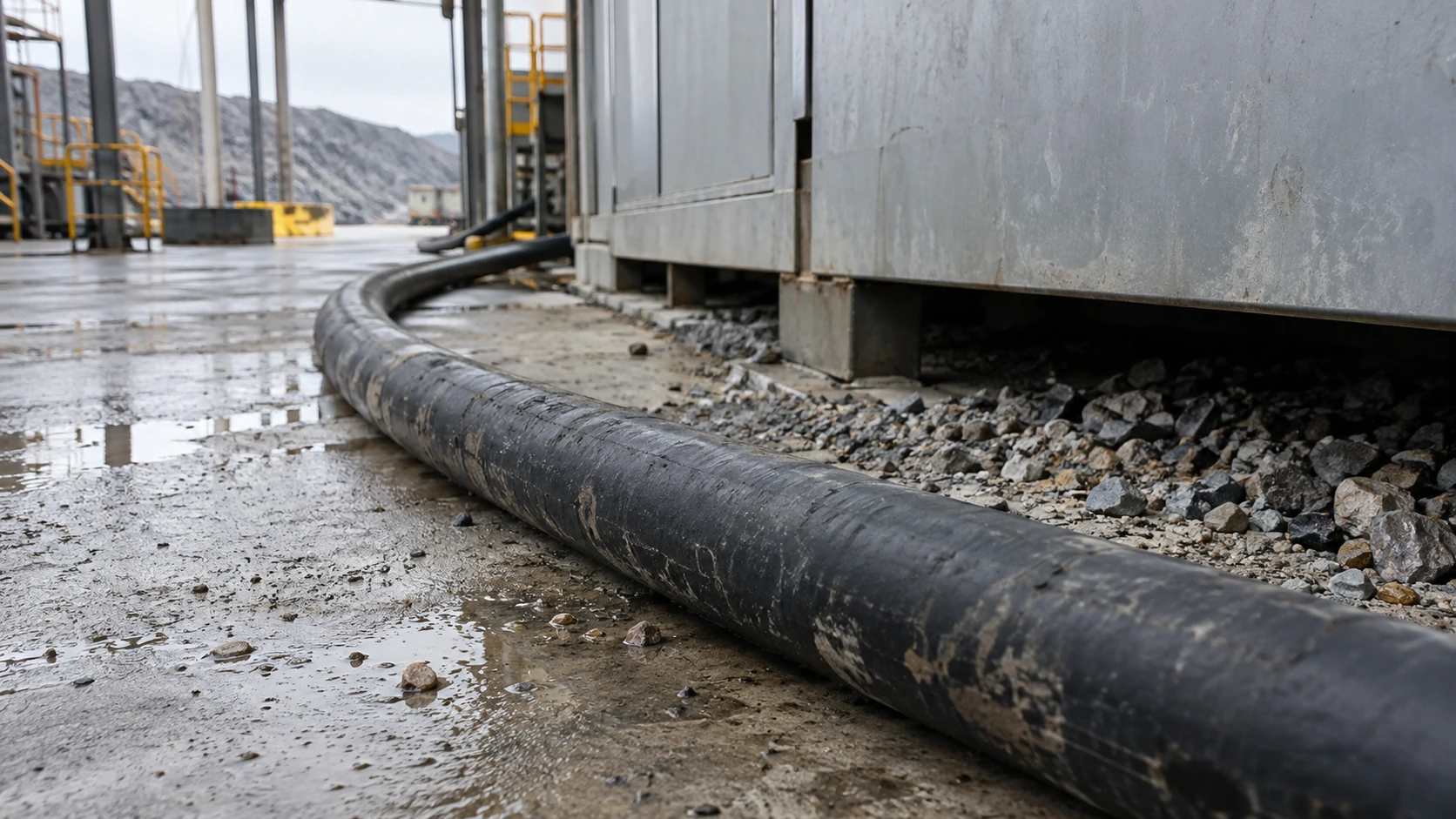
Why Do Mining Cables Use Rubber Insulation and Sheaths?
Many mobile mining cables use rubber compounds because they combine flexibility with mechanical resilience. However, “rubber cable” describes a broad construction category. The insulation and sheath may use different polymers because they perform different functions.
Rubber flexible cables serve portable equipment and demanding industrial applications where movement and environmental exposure occur together. Their suitability depends on the particular cable design. Reference: Eland Cables’ rubber flexible cable overview.
Flexibility and Repeated Bending
A cable supplying moving equipment must bend without placing excessive strain on its conductors, insulation or screens. Flexible insulation helps the assembly accommodate movement, while the sheath must remain intact as the cable changes shape.
However, a cable that bends easily by hand is not necessarily designed for continuous flexing or drum reeling. Dynamic performance also depends on strand diameter, conductor lay, core arrangement, reinforcement and the interaction between layers.
For example, dedicated reeling cable designs may include an anti-torsion braid and specify different operating limits for different variants. These construction features matter alongside the insulation and sheath materials. Reference: NSHTÖU reeling cable construction.
When comparing quotations, ask suppliers to identify the permitted movement and minimum dynamic bending radius. A general description such as “flexible rubber cable” leaves these requirements unresolved.
Abrasion, Impact and Environmental Protection
The outer sheath is the first layer exposed to rough ground, equipment surfaces, oil, sunlight and water. Its job is to protect the internal electrical components while accommodating the intended movement.
Separate the mechanical risks before selecting a jacket:
| Exposure | What the sheath needs to withstand |
|---|---|
| Sliding across rough surfaces | Progressive abrasive wear |
| Contact with sharp edges | Cutting and notch formation |
| Repeated pulling around obstacles | Tear propagation and local strain |
| Falling material or equipment contact | Impact or crushing, assessed with the complete construction |
A jacket with strong abrasion resistance can still be cut by a sharp edge. Likewise, an elastomeric sheath does not make a cable suitable for vehicle run-over.
For oily locations, assess the outer jacket’s oil resistance. EPR insulation itself should not be treated as the cable’s oil-protection layer. Reference: EPR material characteristics.
EPR vs XLPE: Which Insulation Is Better for Mining Cable?
EPR is generally a stronger starting point when flexibility is central to the application; XLPE is a common choice for fixed power distribution. Neither material is automatically superior for every mining circuit.
EPR means ethylene propylene rubber. XLPE means cross-linked polyethylene. Both can provide power-cable insulation, but their mechanical behavior and formulation options differ.
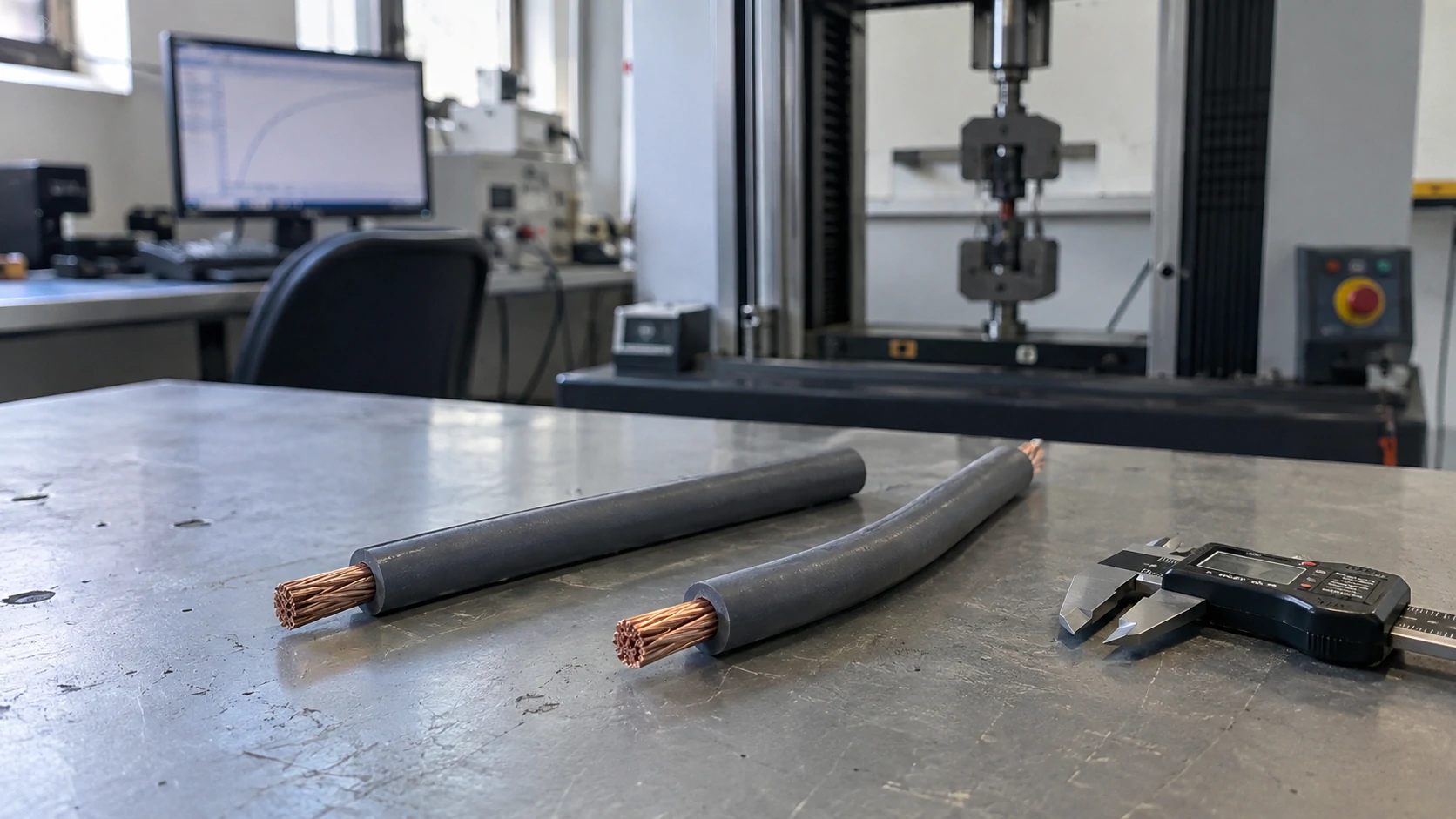
Electrical, Thermal and Flexibility Comparison
EPR generally provides greater flexibility, while XLPE offers low dielectric losses. EPR also has low sensitivity to water treeing, although wet-service suitability must still be established for the complete cable. Reference: EPR insulation comparison.
Cross-linking improves polyethylene’s resistance to deformation at elevated temperatures while retaining its useful electrical properties. It does not establish a universal temperature rating for every XLPE cable. Reference: XLPE insulation characteristics.
| Selection factor | EPR insulation | XLPE insulation |
|---|---|---|
| Flexibility | Commonly selected where an elastic insulation system is useful | Generally less compliant than flexible EPR formulations |
| Electrical performance | Suitable for appropriately designed power cables | Low dielectric losses support power-distribution applications |
| Thermal specification | Confirm the finished cable’s declared rating | Confirm the finished cable’s declared rating |
| Repeated movement | Consider within a tested trailing or reeling construction | Require explicit evidence of suitability for the intended movement |
| Wet operation | Check insulation qualification and complete cable construction | Check insulation qualification and any water-blocking requirements |
Do not copy a polymer’s broad temperature range into a cable specification. The sheath, screens, terminations and installation conditions may impose a lower operating limit.
Mobile Duty vs Fixed Installation
For a moving machine, begin with a cable designed for the actual motion. Then assess its insulation. Trailing, repeated reeling and occasional repositioning place different demands on a cable, even when all three designs use EPR.
For a fixed feeder, compare electrical loading, installation conditions, moisture exposure and mechanical protection. XLPE may be suitable, but EPR can also serve fixed circuits where the specified construction offers practical advantages.
The purchasing distinction is therefore:
- Mobile circuit: require documented suitability for the movement, tension and bending conditions.
- Fixed circuit: require suitability for the installed route, electrical duty and environmental exposure.
Changing only the insulation material does not convert a fixed cable into a reeling cable.
CPE vs PCP, Neoprene and TPU: Which Jacket Should I Choose?
Compare jacket compounds by their verified performance under your site conditions. CPE, PCP and TPU identify material families, each of which contains formulations with different properties.
The terminology also needs clarification:
| Term | Meaning | Selection implication |
|---|---|---|
| CPE | Chlorinated polyethylene | Identify the specific cable-jacket compound and its test requirements |
| PCP | Polychloroprene | Compare the compound grade, not just the abbreviation |
| Neoprene | A trade name commonly associated with polychloroprene | Do not treat it as a separate polymer family from PCP |
| TPU | Thermoplastic polyurethane | Confirm the particular grade, including hydrolysis and temperature performance |
PUR is a broader abbreviation for polyurethane. A specification stating “PUR sheath” should be clarified if a particular TPU formulation is required.
Abrasion, Oil and Chemical Resistance
CPE and PCP are candidates for demanding flexible-cable jackets; TPU deserves consideration where abrasion and tear resistance are priorities. This is a shortlist for evaluation, not a universal ranking.
PCP is used in flexible cable designs that declare resistance to weather, oil and mechanical stresses. An example is Eland’s EPR-insulated, PCP-sheathed H07RN-F construction; that example does not establish mining approval for every PCP cable. Reference: H07RN-F construction and properties.
Specific polyurethane cable jackets can provide oil, abrasion and notch resistance, together with hydrolysis resistance. Those properties belong to the specified formulation and product. Reference: LAPP polyurethane jacket characteristics.
| Jacket candidate | Reason to evaluate it | Information needed before selection |
|---|---|---|
| CPE | A possible match for combined mechanical and environmental exposure | Compound designation, oil exposure results, mechanical properties and temperature limits |
| PCP / Neoprene | Flexible protection where weathering and oil contact are relevant | Actual oil compatibility, aging results and movement limits |
| TPU | An option where wear, notching or tearing drives jacket selection | Abrasion and tear results, hydrolysis behavior, chemical compatibility and flame performance |
“Oil resistant” does not mean resistant to every hydraulic fluid, fuel or cleaning agent. Specify the fluid name, concentration, contact temperature and exposure duration.
For chemical exposure, request compatibility evidence for the finished jacket compound. Base-polymer charts are useful for screening, but additives and blends can change performance.
Cold Flexibility, Tear Strength and UV Exposure
Cold-weather selection must distinguish between storage, fixed operation and movement. A cable may tolerate a lower temperature while stationary than while repeatedly bending. Published reeling-cable specifications demonstrate this distinction. Reference: fixed and flexing temperature limits.
For an outdoor cable, review three separate requirements:
- Cold movement: minimum temperature for bending or reeling.
- Mechanical durability: resistance to tearing after a nick or cut begins.
- Weathering: declared resistance to UV exposure and ozone where applicable.
For TPU, ask whether the grade is polyester-based or polyether-based and request hydrolysis data for wet service. Polyether-based TPU generally offers better resistance to hydrolytic degradation, but the exact grade still matters.
A jacket’s color does not establish its UV resistance. Likewise, TPU does not automatically mean flame-retardant or halogen-free. CPE and PCP contain chlorine and should not be specified as halogen-free materials.
Bare Copper vs Tinned Copper vs Aluminum
Copper is the usual starting point for repeatedly moving mining power cables. Tinned copper adds a protective coating; aluminum needs a separate assessment of electrical sizing, movement and connections.
Conductor material should be selected together with stranding and termination requirements.
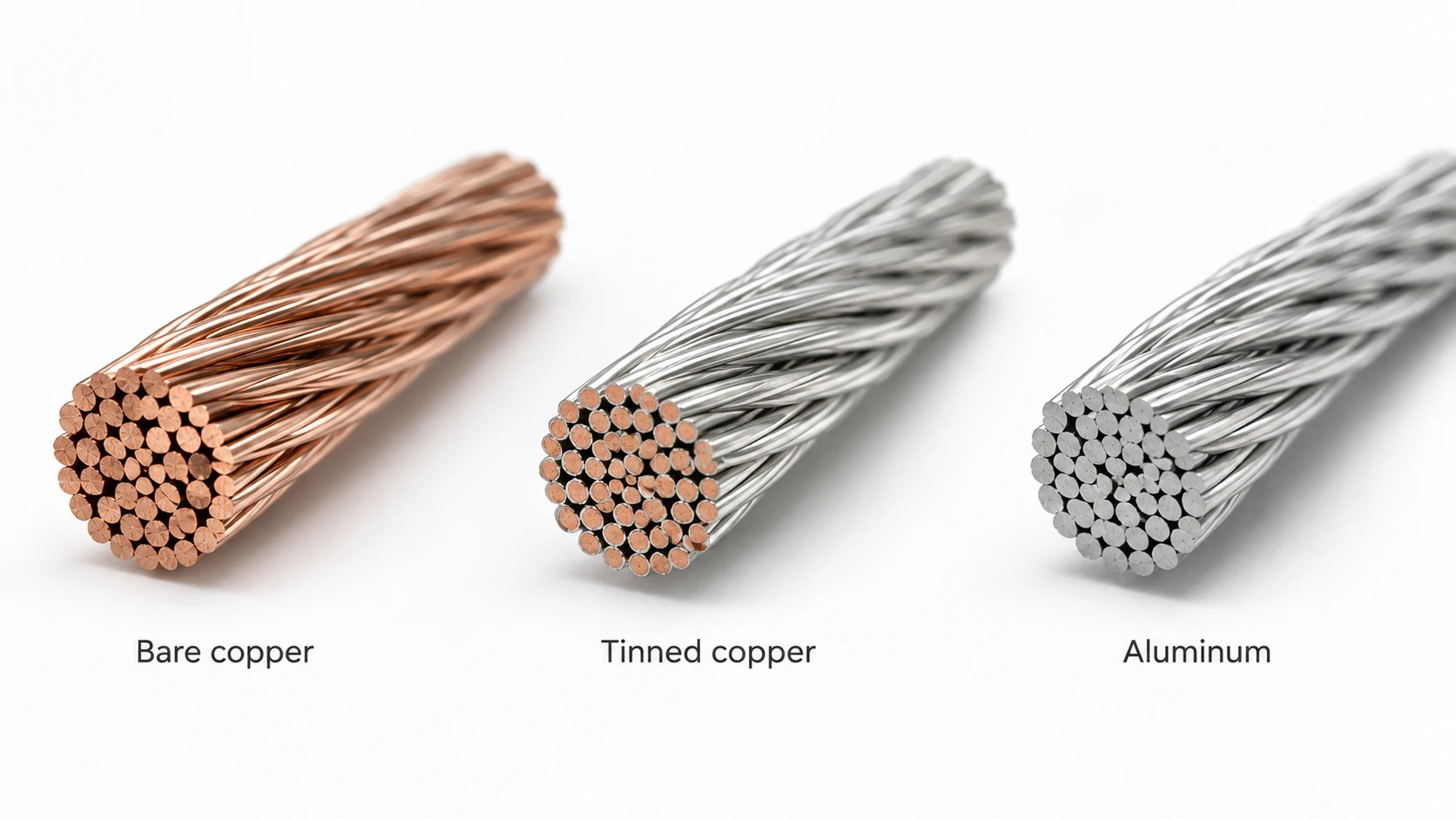
Conductivity, Flexibility and Corrosion Resistance
Bare copper and tinned copper share a copper conductor base. Tin plating is a surface treatment, not a conductivity upgrade. It may be specified to improve corrosion resistance or meet construction and material-compatibility requirements.
| Conductor | Main characteristic | What to verify |
|---|---|---|
| Bare copper | High conductivity with established flexible-conductor constructions | Conductor resistance, stranding and compatibility with surrounding materials |
| Tinned copper | Copper strands with a protective tin coating | Coating requirements, conductor resistance and termination compatibility |
| Aluminum | Lower density but lower conductivity than copper | Revised conductor size, connection system and permitted application |
Flexibility depends heavily on strand size and arrangement. Tinning alone does not prove longer flex life.
Nor does tinned copper make a cable waterproof. If water enters through damaged sheathing or an unsealed termination, the cable still needs corrective action. Water exclusion and conductor corrosion protection are separate design measures.
When Aluminum May or May Not Be Suitable
Aluminum may be considered for a fixed mine feeder when the applicable specification permits it and the complete installation is designed around its properties.
The assessment should include:
- Conductor sizing for current, voltage drop and fault duty.
- Available space for the resulting cable and terminations.
- Connectors approved for the conductor material and strand construction.
- Installation procedures specified by the connector manufacturer.
- Any restrictions imposed by the equipment or project specification.
For repeatedly trailing or reeling circuits, do not accept aluminum as a direct substitution for copper based on nominal cross-sectional area or purchase price. Require a purpose-designed cable with evidence that it meets the movement and electrical requirements.
Copper-clad aluminum is also a distinct conductor construction. It should not be accepted as equivalent to bare copper or tinned copper.
Mining Cable Material Selection Matrix
Use this mining cable insulation and sheath materials matrix to shortlist constructions, then verify them against the actual duty. The recommendations below combine the material distinctions discussed above; they are not approvals or guaranteed performance ratings.
Where several exposures occur together, evaluate the combined conditions. A jacket may perform differently when oil exposure, elevated temperature and repeated bending occur simultaneously.
Wet, Oily, Abrasive and Chemically Exposed Sites
| Site condition | Insulation starting point | Sheath selection direction | Evidence to request |
|---|---|---|---|
| Wet ground and frequent splashing | EPR for mobile duty; qualified EPR or XLPE for fixed duty | A jacket qualified for wet exposure | Water-exposure conditions and termination requirements |
| Prolonged immersion | A complete cable explicitly rated for the immersion duty | Qualified immersion-resistant compound; assess hydrolysis if TPU is proposed | Permitted depth, duration, temperature and water chemistry |
| Oil near mobile equipment | Flexible insulation within the intended cable construction | Compare qualified CPE, PCP or TPU compounds | Results for the relevant fluid and contact temperature |
| Rough ground and abrasive dragging | Insulation within a trailing-rated construction | Compare heavy-duty rubber and abrasion-resistant TPU options | Comparable abrasion and tear data; sheath construction |
| Acids, alkalis or process chemicals | Select for electrical and movement requirements | Shortlist using compound-specific compatibility evidence | Chemical name, concentration, temperature and exposure duration |
| Wet, gritty conditions with repeated movement | A cable designed for the movement | Assess wet aging and mechanical durability together | Evidence addressing both environmental aging and flexing |
For example, a cable that reels beside a wet processing area needs more than an abrasion-resistant jacket. Its supplier should also address water exposure, hydrolysis where relevant, and movement at the lowest operating temperature.
The most useful specification describes the exposure directly: “daily contact with hydraulic fluid during repeated reeling” provides more selection value than “chemical-resistant mining cable.”
Cold, Hot and Outdoor Operating Conditions
| Operating condition | Material selection direction | Required confirmation |
|---|---|---|
| Repeated movement in cold weather | Evaluate a flexible insulation system and a jacket qualified for cold movement | Minimum dynamic operating temperature and bending requirements |
| Cold storage followed by installation | Review the complete cable’s storage and installation limits | Whether conditioning is required before handling |
| High ambient temperature | Check the insulation and sheath together | Allowable conductor temperature and installation-specific current rating |
| Local radiant heat or hot surfaces | Assess routing and protection before relying on a material change | Permitted exposure and any shielding or separation requirements |
| Continuous outdoor exposure | Select a jacket with documented weathering performance | UV and ozone resistance where relevant |
| Cable operating partly wound on a drum | Use a construction qualified for reeling | Current rating for the actual wound condition and drum arrangement |
The final mining cable insulation and sheath materials specification should state both the chosen compounds and the performance they must deliver. Include movement type, temperature limits, water or chemical exposure and the applicable cable requirements.
For a project inquiry to Hualuo Cable, provide the equipment application, voltage, conductor size, core configuration, total length and operating conditions. If an existing cable has failed, describe whether the problem was jacket wear, cracking, swelling, conductor breakage or water entry. That information helps define what the replacement needs to withstand.